
Summary of KRYPTOR FGPA IS A HARDWARE SECURITY MODULE THAT ADDS COMPLEX OPEN-SOURCE ENCRYPTION
Skudo’s Kryptor is a compact, one-chip Hardware Security Module implemented on an Intel/Altera MAX10 FPGA, providing symmetric and asymmetric encryption, hashing, key generation/management, TRNG, and anti-piracy features via serial interfaces and a provided API for maker platforms like Raspberry Pi and Arduino.
Parts used in the Kryptor FPGA HSM:
- Intel/Altera MAX10 8K LE (10M08DAF256C8G) FPGA
- On-chip internal flash (1376 Kb)
- On-chip internal RAM (378 Kb total)
- GPIO pins from the FPGA (250 available)
- SPI serial interface
- I2C serial interface
- UART serial interface
- Control API / encrypted command line interface (CLI) software libraries
- True Random Number Generator (TRNG) module
- Anti-piracy duplication protection via chip ID
Designed for processors that support serial interfaces, the one-chip module offers all the functionalities of a dedicated HSM within a single compact MAX10 FPGA chip.
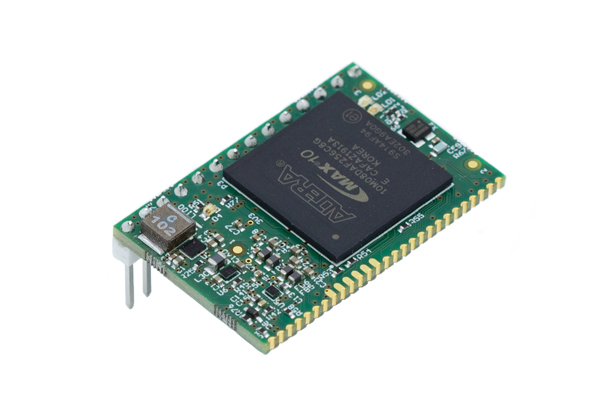
The new release from Skudo is a professional FGPA development board built as an encryption solution to project boards like Raspberry Pi, Arduino, and BeagleBone. It is a plug and play Hardware Security Module that provides a compact pre-configured FPGA chip with functionalities for encrypting data, and can easily be used by any maker board.
“Any controller board (e.g. Raspberry Pi, Arduino etc.) can be connected to the Kryptor PCB via SPI, 12C and UART using a simple data protocol (free Linux API software libraries are also provided) enabling access to the functionalities of the Hardware Security Module (symmetric encryption, asymmetric encryption, hashing, keys generation/storing/management and a True Random Number Generator). Any maker is able to access those functionalities and build complex solutions based on them”.
Features Of The HSM Include:
- FPGA: Intel/Altera MAX10 8K LE (10M08DAF256C8G)
- Dimensions: 23×35 mm
- Internal flash: 1376 Kb
- Internal RAM: 378 Kb total
- GPIO: 250 available from the FPGA (fewer accessible via board)
- Operating frequency: 100 MHz
- Control: API / encrypted command line interface (CLI)
- Platform compatibility: Linux, RPi, Arduino, etc.
- Duplication protection: Anti-piracy duplication protection via chip ID
- Encryption speed: symmetric encryption speed up to 108 Mbps on a single core (SPI link speed capped at 2 Mbps)
Read more: KRYPTOR FGPA IS A HARDWARE SECURITY MODULE THAT ADDS COMPLEX OPEN-SOURCE ENCRYPTION
- What FPGA is used in the Kryptor HSM?
The Kryptor HSM uses an Intel/Altera MAX10 8K LE (10M08DAF256C8G) FPGA. - Can I connect Kryptor to a Raspberry Pi or Arduino?
Yes, Kryptor can be connected to Raspberry Pi, Arduino, and similar maker boards via SPI, I2C, and UART. - What encryption functionalities does the Kryptor provide?
Kryptor provides symmetric encryption, asymmetric encryption, hashing, key generation, storing and management, and a True Random Number Generator. - Is there software support for using the Kryptor HSM?
Yes, free Linux API software libraries and an encrypted command line interface are provided. - What are the memory resources on the Kryptor FPGA?
The FPGA includes 1376 Kb of internal flash and 378 Kb of internal RAM total. - How many GPIOs does the FPGA provide?
The FPGA exposes 250 GPIOs, though fewer are accessible via the board. - What is the operating frequency of the Kryptor FPGA?
The operating frequency is 100 MHz. - Does the Kryptor include anti-duplication protection?
Yes, it includes anti-piracy duplication protection via chip ID. - What is the symmetric encryption speed and SPI limit?
Symmetric encryption reaches up to 108 Mbps on a single core, while SPI link speed is capped at 2 Mbps.
