
Summary of KITTY LITTER AND BROKEN LIGHT BULBS POWER THIS HOMEBREW GAS CHROMATOGRAPH
This article highlights a budget-friendly DIY gas chromatograph built by [Chromatogiraffery] for under $100. The device separates volatile chemical samples using a column packed with bentonite clay (kitty litter) and helium from a party balloon tank. Detection is achieved via cracked incandescent pilot lamps acting as thermal conductivity cells, with data processed by an Arduino using a Wheatstone bridge and differential amplifier. This low-cost build effectively replicates expensive laboratory equipment.
Parts used in the Homebrew Gas Chromatograph:
- Stainless steel tube
- Bentonite clay (kitty litter)
- Helium from a party balloon tank
- Old incandescent pilot lamps (cracked open)
- Wheatstone bridge
- Differential amplifier
- Arduino
We’re always on the lookout for unexpected budget builds here at Hackaday, and stumbling across a low-cost, DIY version of an instrument that sells for tens of thousands of dollars is always a treat. And so when we saw a tip for a homebrew gas chromatograph in the tips line this morning, we jumped on it. (Video embedded below.)
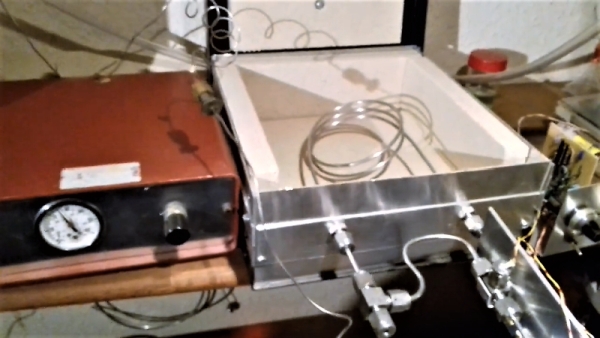
For those who haven’t had the pleasure, gas chromatography is a chemical analytical method that’s capable of breaking a volatile sample up into its component parts. Like all chromatographic methods, it uses an immobile matrix to differentially retard the flow of a mobile phase containing the sample under study, such that measurement of the transit time through the system can be made and information about the physical properties of the sample inferred.
The gas chromatograph that [Chromatogiraffery] built uses a long stainless steel tube filled with finely ground bentonite clay, commonly known as kitty litter, as the immobile phase. A volatile sample is injected along with an inert carrier gas – helium from a party balloon tank, in this case – and transported along the kitty litter column by gas pressure. The sample interacts with the column as it moves along, with larger species held back while smaller ones speed along. Detection is performed with thermal conductivity cells that use old incandescent pilot lamps that have been cracked open to expose their filaments to the stream of gas; using a Wheatstone bridge and a differential amp, thermal differences between the pure carrier gas and the eluate from the column are read and plotted by an Arduino.
The homebrew GC works surprisingly well, and we can’t wait for [Chromatogiraffery] to put out more details of his build.
Source: KITTY LITTER AND BROKEN LIGHT BULBS POWER THIS HOMEBREW GAS CHROMATOGRAPH
- What material serves as the immobile phase?
The project uses finely ground bentonite clay, commonly known as kitty litter. - Where does the carrier gas come from?
Helium is sourced from a party balloon tank. - How are detection components constructed?
Old incandescent pilot lamps are cracked open to expose their filaments to the gas stream. - What circuit measures thermal differences?
A Wheatstone bridge combined with a differential amplifier reads the thermal differences. - Which microcontroller plots the results?
An Arduino is used to read and plot the data. - Can this build separate different chemical species?
Yes, larger species are held back while smaller ones speed along the column. - Is this method suitable for volatile samples?
Yes, the device is designed to break up volatile samples into component parts. - Does the build cost significantly less than commercial units?
Yes, it is a low-cost alternative to instruments that sell for tens of thousands of dollars.
