
Summary of KEITHLEY SMUS EMULATE CLASSIC CURVE TRACERS WITH NEW SOFTWARE
This article discusses Tektronix's Keithley I-V Tracer software, which brings classic curve tracer functionality to modern Keithley SourceMeter units (SMUs). Released to address the high cost and scarcity of vintage instruments, the software utilizes the touchscreen interface of 2400 Series SMUs. It enables users to perform DC, AC, and pulsed DC tracing for low-power two-terminal devices, effectively emulating the familiar user experience of historic Tektronix models like the 576 and 370B while offering modern support and compact size.
Parts used in the Keithley I-V Tracer Project:
- Keithley SourceMeter source measure units (SMUs)
- Keithley I-V Tracer software
- 2400 Series graphical SMUs
- Keithley 2461 dual high-speed digitizers
Tektronix brings many of the key features loved in classic curve tracers to Keithley SourceMeter source measure units (SMUs) with the release of its Keithley I-V Tracer software. Tektronix introduced the industry’s first curve tracer in 1955 to display characteristic curves for vacuum tubes. This was followed by models for testing transistors, diodes, and other solid-state devices. Production of the curve tracers stopped in the mid-1980s.
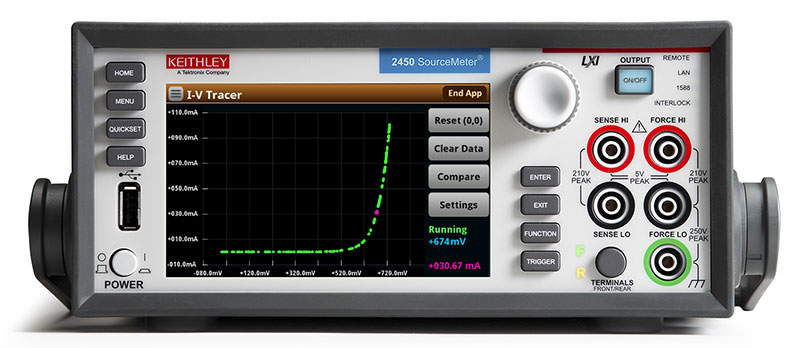
Approximating a power supply and an oscilloscope packaged in the same box, curve tracers source voltage while plotting voltage versus current, said Joseph Gorley, product manager at Keithley. Because an SMU can source voltage or current while measuring voltage and current, it has similar hardware qualities to a curve tracer, he added.
The new software leverages the touchscreen interface of 2400 Series graphical SMUs to recreate the familiar user experience of a curve tracer for low-power two-terminal devices. The Keithley I-V Tracer uses the full capabilities of supported SMUs, including the dual high-speed digitizers of the Keithley 2461, to perform tracing with AC polarity and pulsed DC, in addition to standard DC polarity.
This maps to the classic Tektronix 576, for example, that had +DC, –DC, and AC polarities, which means the output is either + voltage, – voltage, or both + and – voltages, said Gorley.
Keithley I-V Tracer software leverages the touchscreen interface of 2400 Series graphical SMUs to recreate the familiar user experience of a curve tracer for low-power two-terminal devices.
Over the years, curve tracers became more sophisticated, complex, and expensive and are now used primarily for comprehensive semiconductor device-level characterization.
“These advances left an unfilled void for the simple interaction model of classic curve tracers, which continue to be in demand for failure analysis and education applications,” said Gorley. “This has led to a robust market for used traditional curve tracers, with refurbished Tektronix 370Bs fetching $20,000 or more in online auctions.
“Unfortunately, classic instruments are largely impractical due to their cost, limited availability, lack of support, and large footprint. In contrast, Keithley SMUs are a fraction of the size of a classic curve tracer, come with full factory support, and provide the full capabilities of a graphical SMU.”
Read more: KEITHLEY SMUS EMULATE CLASSIC CURVE TRACERS WITH NEW SOFTWARE
- What is the primary function of the new Keithley I-V Tracer software?
The software recreates the familiar user experience of a classic curve tracer for low-power two-terminal devices using modern SMUs. - How does the Keithley I-V Tracer emulate classic Tektronix curve tracers?
It leverages the touchscreen interface of 2400 Series graphical SMUs to mimic the interaction model of historic instruments. - Does the software support AC polarity testing?
Yes, it performs tracing with AC polarity and pulsed DC in addition to standard DC polarity. - Which specific hardware component allows for advanced tracing capabilities?
The dual high-speed digitizers of the Keithley 2461 are utilized to perform complex tracing functions. - Why were classic curve tracers discontinued in the mid-1980s?
The text states production stopped but notes they later became sophisticated, complex, and expensive for general use. - What are the main advantages of using Keithley SMUs over classic curve tracers?
SMUs are a fraction of the size, come with full factory support, and avoid the issues of limited availability and lack of support found in classic instruments. - For what applications do classic curve tracers remain in demand?
They continue to be in demand for failure analysis and education applications due to their simple interaction model. - What was the historical significance of Tektronix introducing curve tracers in 1955?
Tektronix introduced the industry’s first curve tracer in 1955 to display characteristic curves for vacuum tubes.
