
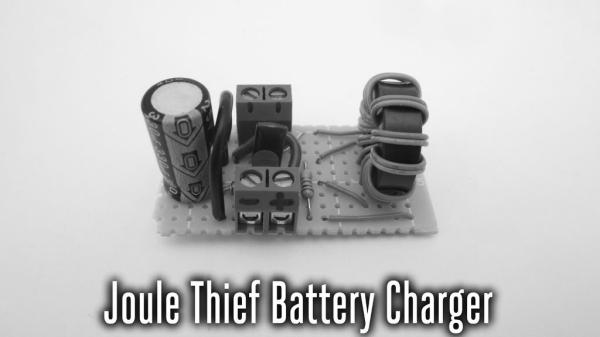
Summary of Joule Thief Low Voltage Battery Charger
A Joule Thief circuit boosts low voltage signals into high-voltage pulses, enabling battery charging from sources like solar cells or thermoelectric generators even when the source voltage is lower than the battery's. This project demonstrates using such a circuit to charge batteries efficiently with minimal power inputs by converting constant low voltage into rapid pulses suitable for charging.
Parts used in the Joule Thief Low Voltage Battery Charger:
- ferrite toroid core
- Insulated Wire
- NPN Transistor (2N2222, 2N3904, or similar)
- 0.01 microfarad Capacitor (capacitor code:103)
- 330 microfarad Capacitor
- 1 kohm resistor
- 6V Zener Diode
- Diode
- Printed Circuit Board or Perf Boarda
A “Joule Thief” is a simple voltage booster circuit. It can increase the voltage of power source by changing the constant low voltage signal into a series of rapid pulses at a higher voltage. You most commonly see this kind of circuit used to power LEDs with a “dead” battery. But there are many more potential applications for this kind of circuit.
In this project, I am going to show you how you can use a Joule Thief to charge batteries with low voltage power sources. Because the Joule Thief is able to boost the voltage of a signal, you are able to charge a battery with a power source whose output voltage is actually lower than the battery itself.
This lets you take advantage of low voltage power sources such as thermoelectric generators, small turbines and individual solar cells.
Step 1: Watch the Video
Here are the materials and tools that you will need to complete this project.
Materials:
ferrite toroid core
Insulated Wire
NPN Transistor (2N2222, 2N3904, or similar)
0.01 microfarad Capacitor (capacitor code:103)
330 microfarad Capacitor
1 kohm resistor
6V Zener Diode
Diode
Printed Circuit Board or Perf Boarda
For more detail: Joule Thief Low Voltage Battery Charger
- What is a Joule Thief?
A simple voltage booster circuit that increases voltage by changing constant low voltage signals into rapid pulses. - Can a Joule Thief charge batteries with lower voltage sources?
Yes, it allows charging a battery with a power source whose output voltage is lower than the battery itself. - How does a Joule Thief work?
It changes a constant low voltage signal into a series of rapid pulses at a higher voltage. - What are some potential applications for this circuit?
Applications include powering LEDs with dead batteries and charging batteries using thermoelectric generators or small turbines. - Which transistor models are recommended for this project?
The article suggests using an NPN Transistor such as 2N2222, 2N3904, or similar. - What capacitor values are required for this build?
You need a 0.01 microfarad capacitor and a 330 microfarad capacitor. - Does the project require a specific type of diode?
Yes, the project requires both a 6V Zener Diode and a standard Diode. - What is the role of the 1 kohm resistor in the circuit?
The 1 kohm resistor is listed as one of the essential materials needed to complete the project. - Can I use a perf board instead of a printed circuit board?
Yes, you can use either a Printed Circuit Board or a Perf Board for this project.
