
Summary of Joule Thief” – no IC and no Transformer
This article describes a robust "Joule Thief" circuit that operates without a transformer or integrated circuit, utilizing only two transistors and basic components. The author shares how the circuit was discovered on Talking Electronics and details modifications to include light-sensing capabilities using a photoresistor and an additional transistor for reliable day/night switching.
Parts used in the Joule Thief - no IC and no Transformer:
- Two transistors (including a PNP transistor Q1)
- Red LED
- White LED
- Photoresistor (CsS Radio Shack style photocell)
- 10k ohm pot (old volume control)
- Inductor (implied by Joule Thief context)
Yep, no transformer and no hard to get IC. But, … two transistors and other parts are required. I actually found this circuit by accident while roaming Colin Mitchell’s Talking Electronics website (talkingelectronics.com).
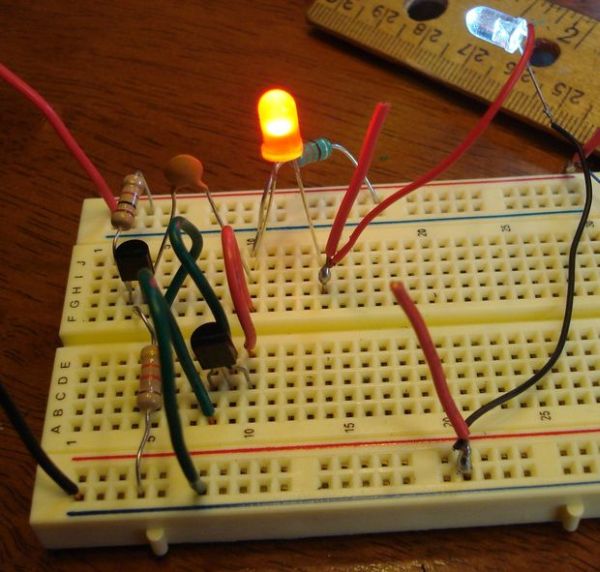
This website is very rich with examples and explanations of a huge variety of circuits. In fact, this website is so abundant in circuits that later on, I couldn’t find the circuit revealed here. Anyhow, I believe that the TE circuit can be considered “robust” as it works even if different parts are used.
red LED in series with the white LED, the circuit draws 15 milliamps @ 48 kHz.
But when using only the white LED, the circuit draws 17 ma @ 38 kHz.
The “Joule Thief” circuit using only easily found parts and no transformer might be attractive to many readers here. This is why I thought it was important to reveal this project.
But in my case, I am still tilted toward the simplicity of a “Joule Thief” circuit using little more than an IC and an Inductor, as revealed in my Instructable, “Joule Thief” Circuits – crude to modern…
And now, I recently had a reader has ask me where I could put a photoresistor in the two transistor “joule thief” circuit to make the circuit turn off in light and turn on in darkness. I really didn’t know but wired a photoresistor between the B plus and the base of the PNP transistor, Q1 (see first schematic below). This sort of worked but light didn’t always shut of the LED – not good enough. I then added another transistor to turn on and off the circuit, where this transistor is controlled by the CsS Radio Shack style photocell and a 10k ohm pot (old volume control). This seemed to work fine as the light/dark trip point could be easily adjusted by the pot (see second schematic below)…
For more detail: Joule Thief” – no IC and no Transformer
- Does this Joule Thief circuit require a transformer?
No, the circuit works without a transformer. - How many transistors are required for this project?
The basic circuit requires two transistors. - Can I add a photoresistor to make the circuit turn off in light?
Yes, a photoresistor can be added with another transistor to control the circuit based on light levels. - What component is used to adjust the light/dark trip point?
A 10k ohm pot is used to easily adjust the trip point. - How much current does the circuit draw with a red LED in series with a white LED?
The circuit draws 15 milliamps at 48 kHz. - What happens if different parts are used in this circuit?
The circuit is considered robust and will still work even if different parts are used. - Where did the author originally find this circuit?
The author found the circuit while roaming Colin Mitchell's Talking Electronics website.
