
Summary of IV9 & IV16 tube numitron clock
This article details a customizable Numitron tube clock project using vintage IV9 and IV16 tubes. The design prioritizes component reusability, allowing the use of various RTC modules (DS3231, DS3234, EPSON RTC4543) and shift registers in either DIP or SMD formats. The dual 5cm x 10cm board supports flexible assembly with through-hole or surface-mount components for resistors and LEDs, ensuring adaptability to local supply chains.
Parts used in the Numitron Tube Clock:
- Vintage IV9 and IV16 tubes
- 74HC595 8-bit shift registers
- Maxim DS3231 RTC module
- Maxim DS3234 RTC module
- EPSON RTC4543 RTC module
- Current limiter resistors (SMD, through-hole, or array)
- SMD or DIP single-color LEDs
- Microcontroller unit (MCU)
- Dual 5cm x 10cm PCB board
Project summary
I found those beautiful vintage IV9 & IV16 tubes and I had to use them, clock being the perfect candidate. I made already mutliple others based on what was supposed to be a WordClock (hence the project name) only, but became more diversified. I did also a first test with a chainable 5cm x 5cm tube board, this is a 5cm x 10cm dual board improved version.
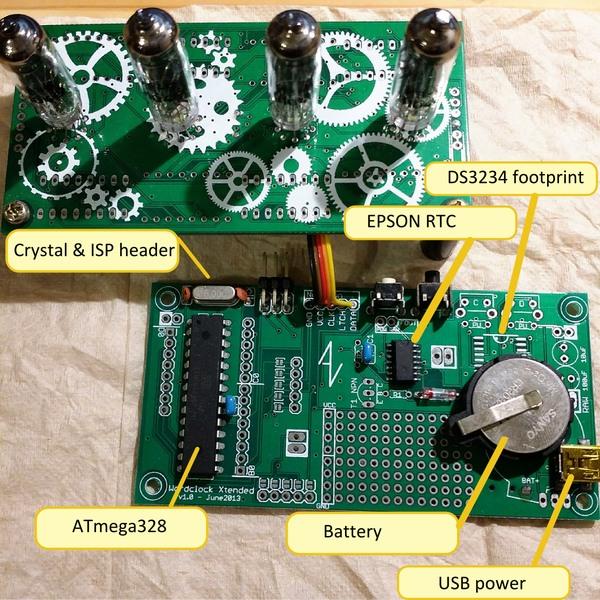
When I made this project and designed it the idea I had was of course the design (very important) but also reusability and pragmaticallity regarding the components used. What I mean by the latest is that you never really know what component you’ll have at hand, depends on your provider, the component availability, it’s price, or even the package DIP or SMD. Hence the board can work with 3 different type of RTC clocks: just use your favorite or the one in your shelf stock. Personally I love the Maxims DS3231 and DS3234 which are temperature compensated (to a fantastic extend for the DS3234), and both are accessed through different protocols: SPI for the DS3234 and TWI for DS3231. There’s also the EPSON RTC4543 for those living in Japan like me. So again depending of what else you need to wire, choose your poison: all the pins of the MCU are accessible and there’s even a small zone for some DIP components.
The top board uses 74HC595 for maintaining the displayed digits: they come very cheap but I didn’t want to be stuck to the DIP or SMD model (having both in stock), so the board can use any of the two. Same goes with the current limiter resistors: SMD, through hole or even resistor array, your pick. And of course there’s a SMD or DIP led footprint under each tube for the blingbling! (single color, not RGB led)
Hall of fame:
- Thanks to Hackaday http://hackaday.com/2015/01/15/numitron-tube-clock/
- Thanks to Electronics-lab http://www.electronics-lab.com/blog/?p=32471
Design
Presentation
Top board (bottom view) holding the tubes, their current limiter resistors and 4x 74HC595 8bits shift registers. Designed to be populated with through holes or SMD components, depending what you get at hand.
Schematics
- Top board with tubes on Google SVN.
- It’s the “extended” version a 100x50mm board
- Works with tubes Tiny Numitron IV-16 and IV-9
- SMD LED under the tubes for nice bling-bling
- Resistors and 74hc595 can be SMD or through-hole
For more detail: IV9 & IV16 tube numitron clock
-
Which vintage tubes are used in this project?
The project uses beautiful vintage IV9 and IV16 tubes. -
Can I use different types of RTC clocks?
Yes, the board works with three types: Maxim DS3231, Maxim DS3234, or EPSON RTC4543. -
Does the design support both DIP and SMD components?
Yes, the board is designed to be populated with either through-hole or SMD components depending on availability. -
What protocol does the DS3234 use?
The DS3234 is accessed through the SPI protocol. -
What protocol does the DS3231 use?
The DS3231 is accessed through the TWI protocol. -
Are RGB LEDs supported for the display bling?
No, the footprint is for single color LEDs only, not RGB. -
What is the size of the improved dual board?
The improved version is a 5cm x 10cm dual board. -
How many shift registers are used on the top board?
The top board holds four 74HC595 8-bit shift registers.
