
Summary of Interfacing MQ2 to Arduino- Gas Sensor for Smoke-Butane-CH4 and LPG
MQ2 is a general-purpose gas and smoke sensor that detects LPG, butane, methane, hydrogen, and smoke. Compared to MQ5, MQ2 has different sensitivity ranges—MQ2 detects LPG only from about 5000–10000 ppm and methane up to 20000 ppm, while MQ5 senses LPG from 200–10000 ppm and methane up to 10000 ppm. Choose MQ2 when higher-range gas detection or smoke sensing is required; choose MQ5 for low-level LPG detection. The article shows how to interface MQ2 with Arduino, including a digital output wiring diagram.
Parts used in the MQ2 Gas Sensor with Arduino:
- MQ2 Gas Sensor module
- Arduino board (e.g., Arduino Uno)
- Jumper wires
- Breadboard (optional)
- Power supply (5V from Arduino)
- Resistor or onboard potentiometer on MQ2 module (for sensitivity adjustment)
In this article, we are going to learn how to interface MQ2 Gas Sensor with Arduino. MQ2 is basically a general purpose gas sensor (similar to MQ5) which can sense a broad range of gases like LPG, Butane, Methane(CH4), Hydrogen and in addition to these gases MQ2 is sensitive to smoke as well.
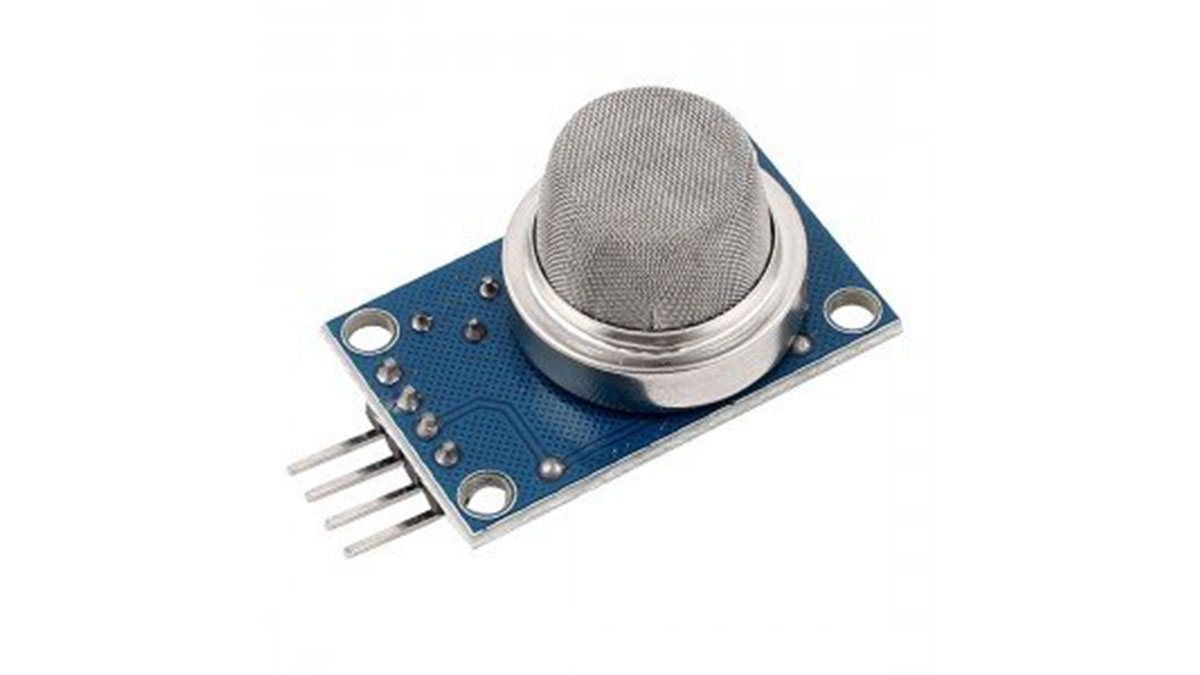 In a previous article, we have wrote a tutorial on Interfacing MQ5 Gas sensor to Arduino. Both MQ5 and MQ2 are basically gas sensors but their range of sensing different gas levels vary. For example, MQ5 can sense LPG in a broader range of 200 ppm to 10000 ppm, where as the range of MQ2 for LPG is short and is from 5000 ppm to 10000 ppm. Similarly MQ2 is sensitive to smoke where as MQ5 is not that sensitive to smoke. So we can not choose MQ5 gas sensor to design a smoke alarm or smoke involving applications. MQ2 can sense methane(CH4) upto 20000 ppm where as MQ5 can sense CH4 only upto 10000 ppm. The difference between MQ5 and MQ2 therefore lies in its range of values. We choose the right sensor based on the application requirement; say for example – We can not choose MQ2 for sensing low levels of LPG in the range of 700 ppm because MQ2 is insensitive low levels of LPG (its range begins at 5000 ppm and extends to 10000 ppm). So for applications to sense low levels of LPG, MQ5 is the ideal choice as it can sense values starting from 200 ppm.
So here are our circuit diagrams!
Interfacing MQ2 to Arduino using Digital Out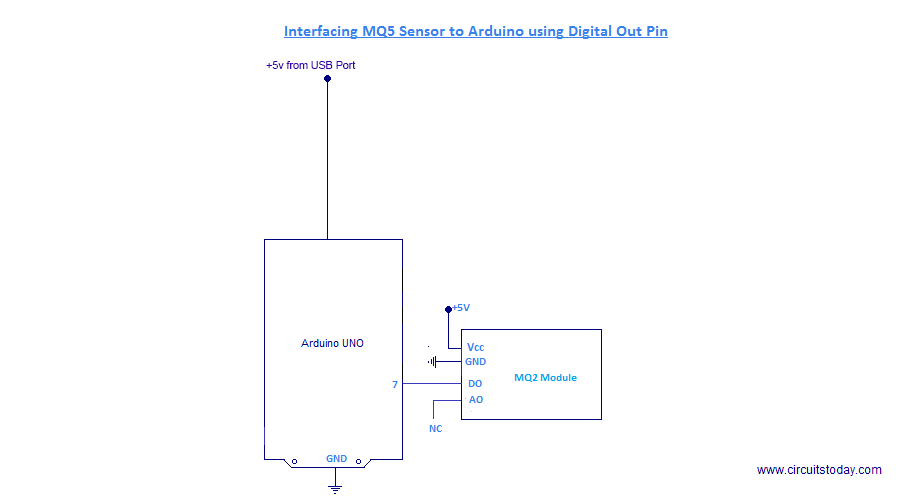
- What gases can MQ2 detect?
MQ2 can sense LPG, butane, methane (CH4), hydrogen, and smoke. - Can MQ2 detect smoke?
Yes, MQ2 is sensitive to smoke. - How does MQ2 compare to MQ5 for LPG detection?
MQ2 senses LPG from about 5000 to 10000 ppm, whereas MQ5 senses LPG from about 200 to 10000 ppm, so MQ5 is better for low-level LPG detection. - Can MQ2 detect methane better than MQ5?
Yes, MQ2 can detect methane up to 20000 ppm while MQ5 detects methane up to 10000 ppm. - Should I use MQ2 for a smoke alarm project?
Yes, MQ2 is suitable for smoke alarm or smoke-involving applications because it is sensitive to smoke. - Can MQ2 be used to sense low levels of LPG like 700 ppm?
No, MQ2 is insensitive to low LPG levels and is not suitable for detecting around 700 ppm. - How is MQ2 interfaced to Arduino in the article?
The article shows interfacing MQ2 to Arduino using the sensor module's digital output connection.
