Home > Projects > Other Projects > Hello World with Arduino/Genuino MKR1000: Relay Board and AP

Hello World with Arduino/Genuino MKR1000: Relay Board and AP

Summary of Hello World with Arduino/Genuino MKR1000: Relay Board and AP


The author created a project using the Arduino MKR1000 to demonstrate its capabilities beyond a basic "Hello World" app. The setup involves soldering headers, installing the board in the Arduino IDE, and coding an Access Point with a built-in HTTP server. This server allows users to control a connected relay board via web browser links to switch channels on or off. The system operates by listening for GET requests on port 81 and responding with status updates or commands to toggle the relay state.

Parts used in the MKR1000 Relay Project:

  • Arduino MKR1000
  • Relay (generic)

Not the simple “Hello World” app but a semi-serious play with the MKR1000.
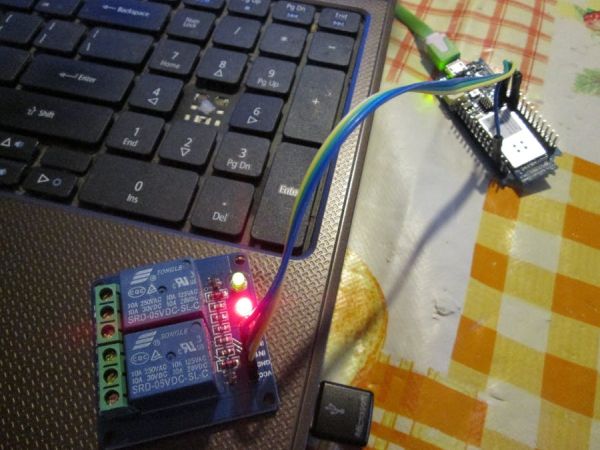
Things used in this project

Hardware components

Arduino MKR1000
Arduino MKR1000
× 1
Relay (generic)
× 1

Story

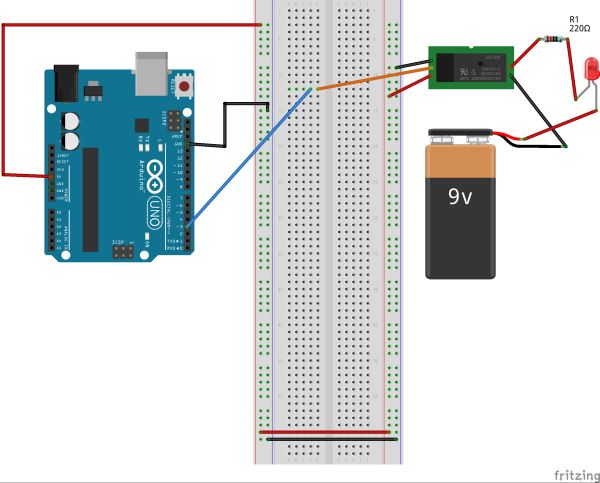
Schematics

Fritzing file

Code

HelloWorld

Arduino

/**
 * DOCS: 
 *  https://github.com/arduino-libraries/WiFi101/
 */


#include <SPI.h>
#include <WiFi101.h>


// Settings & vars for the AP
char ssid[] = "dridif-greenhouse";
char pass[] = "hackme"; // (not supported yet)
int wifi_status = WL_IDLE_STATUS;

// Settings and vars for the HTTP server
int http_port = 81;
WiFiServer http_server(http_port);
WiFiClient http_client;

// Settings and vars for the relays
byte PIN_relay_pump = 3;
byte relay_pump_status = 0;

byte debug_mode = 1;

void wifi_connect_as_ap() {
  // Is it IDLE ?
  if (wifi_status == WL_IDLE_STATUS) {
    // Try to connect
    wifi_status = WiFi.beginAP(ssid);
    // Wait 10 seconds for connection
    delay(4000);
    _debug_wifi_status();
    // Is it connected?
    wifi_connect_as_ap();
  }
}


void setup() {
  // Setup Serial
  while (!Serial);
  delay(1000);
  Serial.begin(9600);

  // Check for the presence of the shield
  if (WiFi.status() == WL_NO_SHIELD) {
    Serial.println("WiFi shield not present");
    while (true);       // don't continue
  }

  // Create the AP
  wifi_connect_as_ap();

  // Start the HTTP server
  http_server.begin();

  // Init the relay board
  pinMode(PIN_relay_pump, OUTPUT);
  digitalWrite(PIN_relay_pump, LOW);
}

byte _is_a_get_request(String txt) {
  String tmp = _get_request_path(txt);
  if (tmp == "N/A") {
    return 0;
  }
  return 1;
}

/**
 * @returns "N/A" if txt is not the right header 
 */
String _get_request_path(String txt) {
  if (txt.endsWith("HTTP/1.1")) {
    txt = txt.substring(0, txt.indexOf("HTTP/1.1"));
    if (txt.startsWith("GET")) {
      txt = txt.substring(3);
      txt.trim();
      Serial.println("Requesting " + txt); 
      return txt;
    }
  }
  return "N/A";
}

String _html_show_on_off_status(int status) {
  if (status == 0) {
    return "<span style='color:red;'><strong>OFF</strong></span>";
  }
  return "<span style='color:green;'><strong>ON</strong></span>";
}

void process_http_request(String path) {
  if (path == "/") {
    http_client.println("Status Relay: "+_html_show_on_off_status(relay_pump_status));
    http_client.println("<hr>Actions: <ul>");
    http_client.println("<li><a href='/pump_relay_on'>START Pump Relay</a></li>");
    http_client.println("<li><a href='/pump_relay_off'>STOP Pump Relay</a></li>");
    http_client.println("</ul>");
  } else if (path == "/pump_relay_off") {
    http_client.println("Pump Relay OFF");
    http_client.println("<hr>[<a href='/'>Back to Index</a>]");
    digitalWrite(PIN_relay_pump, LOW);
    relay_pump_status = 0;
  } else if (path == "/pump_relay_on") {
    http_client.println("Pump Relay ON");
    http_client.println("<hr>[<a href='/'>Back to Index</a>]");
    digitalWrite(PIN_relay_pump, HIGH);
    relay_pump_status = 1;
  } else {
    http_client.println("404");
  }
}

void process_http_requests() {
  // Listen for incoming http_clients
  http_client = http_server.available();
  byte tmp_request_is_a_get_request = 0;
  String tmp_get_request_line = "";

  if (http_client) {                             // if you get a http_client,
    Serial.println("New client connected.");           // print a message out the serial port
    String currentLine = "";                // make a String to hold incoming data from the http_client
    while (http_client.connected()) {            // loop while the http_client's connected
      if (http_client.available()) {             // if there's bytes to read from the http_client,
        char c = http_client.read();             // read a byte, then
        // Serial.write(c);                    // print it out the serial monitor
        if (c == '\n') {
          // If the current line is blank, you got two newline characters in a row.
          // that's the end of the client HTTP request, so send a response:
          if (currentLine.length() == 0) {
            // HTTP headers always start with a response code (e.g. HTTP/1.1 200 OK)
            // and a content-type so the client knows what's coming, then a blank line:
            http_client.println("HTTP/1.1 200 OK");
            http_client.println("Content-type:text/html");
            http_client.println();
            if (tmp_request_is_a_get_request == 1) {
              process_http_request(_get_request_path(tmp_get_request_line));
            }
            break;
          }
          
          // We don't really care about other headers .. just the /GET ones
          if (_is_a_get_request(currentLine)) {
            tmp_request_is_a_get_request = 1;
            tmp_get_request_line = currentLine;
          }
          // Clear the currentLine buffer
          currentLine = "";
        }
        else if (c != '\r') {
          // Add to the currentLine buffer
          currentLine += c;
        }
      }
    }
    // close the connection:
    http_client.stop();
    Serial.println("Client disconnected.");
  }
}


void loop() {
  process_http_requests();
  
}


////////////////////////
// Non-core functions //
////////////////////////

void _debug_wifi_status() {
  if (debug_mode == 1) {
    // print the SSID of the network you're attached to:
    Serial.print("SSID: ");
    Serial.println(WiFi.SSID());
  
    // print your WiFi shield's IP address:
    IPAddress ip = WiFi.localIP();
    Serial.print("IP Address: ");
    Serial.println(ip);
  
    // print the received signal strength:
    long rssi = WiFi.RSSI();
    Serial.print("signal strength (RSSI):");
    Serial.print(rssi);
    Serial.println(" dBm");
    // print where to go in a browser:
    Serial.print("To see this page in action, open a browser to http://");
    Serial.print(ip);
    Serial.print(":");
    Serial.print(http_port);
    Serial.println();
  }    
}

Source : Hello World with Arduino/Genuino MKR1000: Relay Board and AP

Quick Solutions to Questions related to MKR1000 Relay Project:

  • How do I connect the relay to the MKR1000?
    Connect Digital Pin 3 to the IN of the relay board.
  • What network mode does the MKR1000 use in this project?
    The board creates an Access Point (AP) named dridif-greenhouse.
  • Can I access the control page from any device?
    Yes, any HTTP capable client like a browser can send requests to the server.
  • Which port does the HTTP server listen on?
    The server is configured to listen on port 81.
  • How do I turn the pump relay ON?
    Navigate to the link /pump_relay_on in your browser.
  • How do I turn the pump relay OFF?
    Navigate to the link /pump_relay_off in your browser.
  • What happens if I visit a non-existent path?
    The server responds with a 404 error message.
  • Does the code check for the presence of the WiFi shield?
    Yes, the setup function checks if the shield is present before proceeding.

About The Author

Ibrar Ayyub

I am an experienced technical writer holding a Master's degree in computer science from BZU Multan, Pakistan University. With a background spanning various industries, particularly in home automation and engineering, I have honed my skills in crafting clear and concise content. Proficient in leveraging infographics and diagrams, I strive to simplify complex concepts for readers. My strength lies in thorough research and presenting information in a structured and logical format.

Follow Us:
LinkedinTwitter
Scroll to Top