
Summary of Flashing a Nixie with an Arduino
This article outlines the early prototyping stages of a nixie tube clock project. The author discusses sourcing components in bulk to reduce costs, specifically ordering various resistor values from Digi-Key. Additionally, they acquired IN-12 tubes for display digits and brown-colored IN-3 tubes for colons, noting that the discoloration is typical for new-old-stock items found on eBay.
Parts used in the Nixie Clock:
- IN-12 Nixie Tubes
- IN-3 Nixie Tubes (for colons)
- 3.3K Resistors
- 4.7K Resistors
- 27K Resistors
- 33K Resistors
- Arduino
I’m starting to source parts for my nixie tube experiments. I’m in the very early stages of prototyping a nixie clock. My Breakout Boards were a bust, but that’s not stopping me from pushing on with the nixie-tinkering.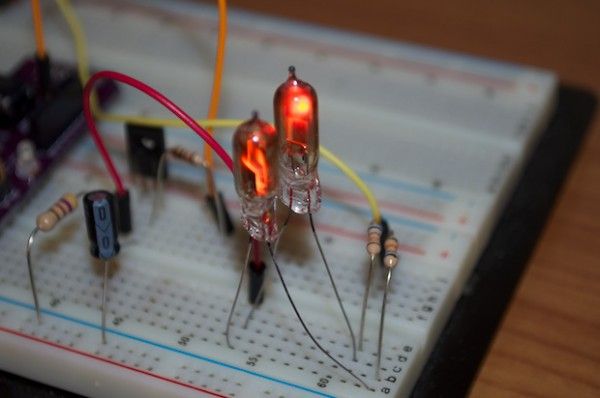
When it comes to resistors, it’s so much cheaper to buy in bulk. It’ll take me a lifetime to use up these 3.3K, 4.7K, 27K, and 33K resistors, but when you buy a bag of 100 from Digi-Key, they’re only 3 cents a piece.
I already have the IN-12s I’ll be using for the clock, I just needed to order some IN-3s to serve as colons. The eBay seller swears these are new-old-stock. I was surprised to see have brown they are. Maybe that’s just what happens to them after a few decades in the box. I looked at a bunch of auctions on eBay. Pretty much all of them being sold as “new” are this brown. So I guess it’s normal.
For more detail: Flashing a Nixie with an Arduino
- Why buy resistors in bulk?
Buying in bulk is much cheaper, costing only 3 cents per piece when purchasing a bag of 100. - Where did the author source the resistors?
The resistors were ordered from Digi-Key. - What resistor values are being used?
The project uses 3.3K, 4.7K, 27K, and 33K resistors. - Which Nixie tubes serve as colons?
The IN-3 tubes are intended to serve as colons. - What condition are the IN-3 tubes in?
The IN-3 tubes appear brown, which is normal for new-old-stock after decades in storage. - How does the author verify the tube condition?
The author checked multiple eBay auctions and observed that most sold as new share this brown color. - What was the status of the breakout boards?
The breakout boards failed, but the author continues with the nixie-tinkering. - What is the primary goal of this project?
The goal is to prototype a nixie clock.
