
Summary of EVALUATION BOARD IMPLEMENTS A 5 V – 1.8 W ISOLATED FLYBACK CONVERTER
The STEVAL-VP22201B is a compact evaluation board implementing a 5 V, 1.8 W isolated flyback converter for 85–265 VAC mains. It uses the VIPer222XSTR offline high-voltage converter (730 V MOSFET, PWM current-mode control) and offers low BOM, low standby consumption (<18 mW at 230 VAC), tight line/load regulation, and burst mode for very low no-load power via reduced switching frequency.
Parts used in the STEVAL-VP22201B:
- STEVAL-VP22201B evaluation board (reference design)
- VIPer222XSTR offline high-voltage converter IC (VIPerPlus family)
- 730 V Power MOSFET (integrated in VIPer222XSTR)
- Flyback transformer (isolation and energy transfer)
- Input EMI and mains components for 85–265 VAC operation
- Output rectifier and filtering components for 5 V output
- Feedback network for PWM current-mode control
- Passive components: resistors, capacitors, inductors as required by reference design
- PCB and connectors for input and 5 V output
The STEVAL-VP22201B evaluation board implements a 5 V – 1.8 W isolated flyback converter developed for general purpose applications operating from 85 to 265 VAC.
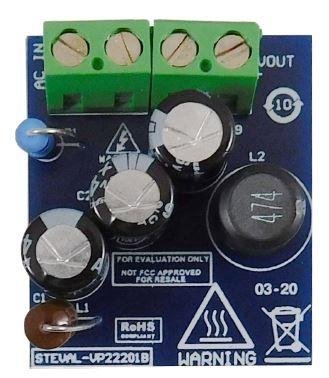
The reference design is built around the VIPer222XSTR offline high-voltage converter from the VIPerPlus family, with 730 V Power MOSFET and PWM current-mode control.
The main characteristics of the evaluation board are its small size and minimal BOM, low stand-by consumption and tight line and load regulation over the entire input and output range. Extremely low consumption under no-load condition is ensured thanks to burst mode operation that reduces the average switching frequency and minimizes all frequency related losses.
ey Features
- Universal input mains range: 85–265 VAC
- Frequency: 50-60Hz
- Output voltage: 5 V
- Output current: 360 mA
- Very compact size
- Stand-by mains consumption: < 18mW at 230 VAC
- Tight line and load regulation over the entire input and output range
Read more: EVALUATION BOARD IMPLEMENTS A 5 V – 1.8 W ISOLATED FLYBACK CONVERTER
- What input voltage range does the STEVAL-VP22201B support?
The board supports a universal input mains range of 85–265 VAC at 50–60 Hz. - What is the output voltage and current of the evaluation board?
The output is 5 V with an output current of 360 mA (1.8 W). - Which controller IC is used in the design?
The design is built around the VIPer222XSTR offline high-voltage converter from the VIPerPlus family. - How does the board achieve low no-load consumption?
It uses burst mode operation to reduce the average switching frequency and minimize frequency related losses, ensuring extremely low consumption under no-load. - What is the standby mains consumption at 230 VAC?
Stand-by mains consumption is less than 18 mW at 230 VAC. - Does the design provide tight regulation?
Yes, it provides tight line and load regulation over the entire input and output range. - What switching/topology is implemented on the board?
The board implements an isolated flyback converter topology. - What MOSFET voltage rating is associated with the controller?
The VIPer222XSTR includes a 730 V power MOSFET.
