
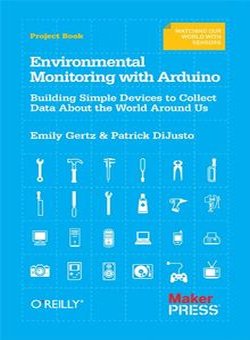
Summary of Environmental Monitoring with Arduino by Emily Gertz E-Book
Environmental Monitoring with Arduino teaches DIYers how to build Arduino-based devices to measure noise, weather, EMI, water purity, energy vampirism, and radiation, plus how to collect and share data online. It includes an intro to circuits and Arduino programming, guidance for using a microphone/amplifier for noise monitoring, making a water conductivity tester, building a Geiger counter, extending Arduino with an Ethernet shield, and sharing data via Pachube.
Parts used in the Environmental Monitoring with Arduino:
- Arduino microcontroller
- Special microphone
- Microphone amplifier
- Water conductivity sensor/probes
- Temperature sensor
- Humidity sensor
- Geiger counter tube and associated circuitry
- Electromagnetic interference (EMI) sensing components
- Ethernet shield
- Wiring, breadboard, and basic electronic components (resistors, capacitors, etc.)
After the devastating tsunami in 2011, DYIers in Japan built their own devices to detect radiation levels, then posted their finding on the Internet. Right now, thousands of people worldwide are tracking environmental conditions with monitoring devices they’ve built themselves. You can do it too!
This inspiring guide shows you how to use Arduino to create gadgets for measuring noise, weather, electromagnetic interference (EMI), water purity, and more. You’ll also learn how to collect and share your own data, and you can experiment by creating your own variations of the gadgets covered in the book. If you’re new to DIY electronics, the first chapter offers a primer on electronic circuits and Arduino programming.
- Use a special microphone and amplifier to build a reliable noise monitor
- Create a gadget to detect energy vampires: devices that use electricity when they’re “off”
- Examine water purity with a water conductivity device
- Measure weather basics such as temperature, humidity, and dew point
- Build your own Geiger counter to gauge background radiation
- Extend Arduino with an Ethernet shield—and put your data on the Internet
- Share your weather and radiation data online through Pachube
Link to Purchase E-Book:
Environmental Monitoring with Arduino by Emily Gertz E-Book
Purchase Arduino by Emily Gertz E-Book
- Can I build a noise monitor with Arduino?
Yes; the book shows how to use a special microphone and amplifier to build a reliable noise monitor. - How can I detect energy vampires?
The guide describes creating a gadget that detects devices that use electricity when they appear off. - Does the book cover measuring water purity?
Yes; it explains examining water purity with a water conductivity device. - What weather measurements can I make?
You can measure temperature, humidity, and dew point as described in the book. - Can I build a Geiger counter with Arduino?
Yes; the book explains how to build your own Geiger counter to gauge background radiation. - How do I put my Arduino data on the Internet?
The book shows how to extend Arduino with an Ethernet shield and put your data online. - Can I share data online from these devices?
Yes; the book explains sharing weather and radiation data online through Pachube. - Is there introductory material for beginners?
Yes; the first chapter offers a primer on electronic circuits and Arduino programming for newcomers.
