
Summary of DUO Light Computer Using Arduino
The DUO Light is an affordable single-board computer designed for hobbyists, combining features of the Arduino UNO and Raspberry Pi. It runs on an ATMega328 microcontroller paired with 64 KB SRAM to execute proprietary DLBC programs loaded from an SD card. The system supports composite video output, PS/2 keyboard input, and general-purpose I/O ports. Users can write software in Pseudo C or assembly, enabling applications like text editors, calculators, and even a self-hosting assembler.
Parts used in the DUO Light:
- ATMega328 microcontroller
- 64 KB serial SRAM
- Composite video monitor
- PS/2 keyboard
- SD card
- General purpose I/O ports
An inexpensive single board computer which connects to a composite video monitor, keyboard, and SD card.
I created the DUO Light as a low cost platform for hobbyists to create fun and useful software. The DUO Light is ideal for anyone who wants a low power computer with video output and keyboard input.
DUO Light Hardware
The DUO Light is a hybrid of the Arduino UNO and the Raspberry Pi, but costs less than each. At the heart of the DUO Light is the ATMega328, the same microcontroller as in the Arduino UNO. This chip connects to a variety of peripheral devices, including a composite video monitor and SD card (in a similar fashion to the Raspberry Pi), PS/2 keyboard, and general purpose I/O ports. The second chip onboard is a 64 KB serial SRAM, which also connects to the ATMega328.
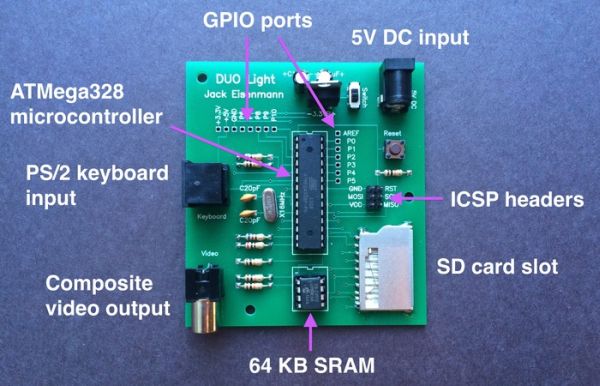
DUO Light Software
Each DUO Light is preinstalled with an interpreter for DUO Light bytecode (DLBC), a proprietary binary language. DLBC programs are loaded from files on the SD card and executed in SRAM. DLBC features over 90 opcodes and a robust argument system.
You can write DLBC programs using either DUO Light pseudo C or assembly. DUO Light pseudo C is a C-like language which includes many features of C and some additional features.
Pseudo C programs I have written include:
- Mandelbrot set viewer
- Expression calculator
- Hex editor
- Text editor
- Assembler (which runs on the DUO Light!)
- Port manipulator
The DUO Light emulator runs on Windows computers and Macs. Using the emulator helps avoid wear and tear on SD components.
For more detail: DUO Light Computer
- What is the primary function of the DUO Light?
It serves as a low-cost platform for hobbyists to create fun and useful software with video output and keyboard input. - Which microcontroller powers the DUO Light?
The ATMega328 microcontroller, which is the same chip found in the Arduino UNO. - How are DLBC programs executed?
Programs are loaded from files on the SD card and executed in the onboard 64 KB SRAM. - Can users write code using languages other than assembly?
Yes, users can write DLBC programs using DUO Light pseudo C, which is a C-like language. - Does the DUO Light support external storage?
Yes, it connects to an SD card to load bytecode programs. - What types of peripherals does the device connect to?
It connects to a composite video monitor, PS/2 keyboard, SD card, and general purpose I/O ports. - Is there a way to test programs without using physical hardware?
Yes, a DUO Light emulator runs on Windows computers and Macs to avoid wear and tear on SD components. - What is the cost comparison of the DUO Light?
The DUO Light costs less than both the Arduino UNO and the Raspberry Pi.
