
Summary of DIY PECS BOARD USES PICTURES TO COMMUNICATE
This article describes an open-source Picture Exchange Communication System (PECS) board designed by Alain Mauer for his non-verbal son, Scott. Unlike expensive commercial boards, this custom device offers personalized photos and audio feedback. It features a rugged laser-cut MDF enclosure to withstand rough handling, powered by an Arduino Pro Mini and a DF Player Mini. The system uses a 16-key capacitive keypad to trigger specific sound clips from a micro SD card and includes smart features like inactivity timers and low-battery warnings.
Parts used in the DIY PECS Board:
- Laser-cut MDF enclosure
- Arduino Pro Mini
- DF Player Mini
- Micro SD card
- 16-key copper foil capacitive keypad
One way of communicating with autistic and non-verbal people is through the use of a Picture Exchange Communication System or PECS board, which they can use to point out what they need or want throughout the day. However, the commercial versions of these boards have their share of problems — they’re expensive, and they’re fairly rigid as far as the pictures go. [Alain Mauer] has created an open-source PECS board that is far more personalized, and has audio to boot.
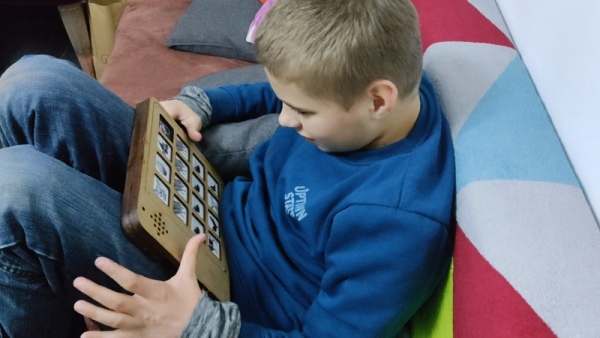
The number one requisite here is sturdiness, as [Alain]’s son [Scott] has already smashed two smartphones and a tablet. [Alain] went with a laser-cut MDF enclosure that should last quite a while. Inside is an Arduino Pro Mini and a DF Player Mini that plays corresponding clips from a micro SD card whenever [Scott] presses a button on the 16-key copper foil capacitive keypad. This PECS board is smart, too — it will sound a turn-me-off reminder after a few minutes of inactivity, and issue audible low battery warnings.
So far, [Scott] is responding better to photographs of objects than to drawings. Watch him interact with the board after the break.
This is far from the first thing [Alain] has built to help [Scott]. Be sure to check out this Pi-based media player built to engage and not enrage.
Source: DIY PECS BOARD USES PICTURES TO COMMUNICATE
- Why did the creator choose a laser-cut MDF enclosure?
To ensure sturdiness because the user has previously smashed smartphones and tablets. - How does the board generate audio when a button is pressed?
The DF Player Mini plays corresponding clips stored on a micro SD card. - What type of keypad is used to interact with the board?
A 16-key copper foil capacitive keypad is used. - Does the board have any automatic power management features?
Yes, it sounds a turn-me-off reminder after minutes of inactivity. - Can the board alert users about battery status?
Yes, it issues audible low battery warnings. - What kind of images does the user respond to better?
The user responds better to photographs of objects than to drawings. - What problem do commercial PECS boards often have?
They are expensive and fairly rigid regarding the pictures available. - Is this project open-source?
Yes, the article states that Alain created an open-source PECS board.
