
Summary of Decoding Russian Meteor-M2 satellite images in real time
The Meteor-M N2 is a Russian polar-orbiting weather satellite launched in 2014, used for forecasting and climate monitoring. It transmits high-resolution digital LRPT images at 137.1 MHz, which can be received using an RTL-SDR dongle. The article details the necessary hardware, software plugins like QPSK for SDR#, and tracking tools such as Orbitron to decode real-time weather imagery superior to older analog NOAA signals.
Parts used in the Meteor-M N2 Satellite Reception Project:
- RTL-SDR dongle (specifically R820T unit)
- 137 MHz antenna (V-Dipole or DIY Quadrafilar Helix)
- 2m band ham radio antenna
- Dual band 2m/70 cm ham radio antenna
- Computer running Linux
- SDR# software
- QPSK demodulator plugin
- Lrptdecoder software
- Orbitron tracking software
- DDE plugin
The Meteor-M N2 is a polar orbiting Russian weather satellite that was launched on July 8, 2014. Its main missions are weather forecasting, climate change monitoring, sea water monitoring/forecasting and space weather analysis/prediction. Meteor-M N2 transmits images using the digital LRPT protocol at around 137.1 MHz with can be received with an RTL-SDR. The chipset of RTL dongles was created with the intention of doing DVB-T (digital TV) and DAB (digital radio) demodulation , however a curious linux developer named Antti Palosaari, discovered that these cheap TV adapters are actually Sofware Defined Radios (SDR)!
If you don’t have experience with SDR or SDR# software you can take a look at my RTL-SDR analog receiver tutorial. These receiver dongles used to sell for $20, but are now going for around $15, for most cases R820T unit is the better choice. You will need a 137 Mhz antenna check plan for the easy to produce V-Dipole by Adam-9A4QV or a DIY Quadrafilar Helix Antenna. But trust me this signal from space is powerful and almost any 2m band (144 Mhz) or 2m/70 cm dual band ham radio antenna will work good enough.
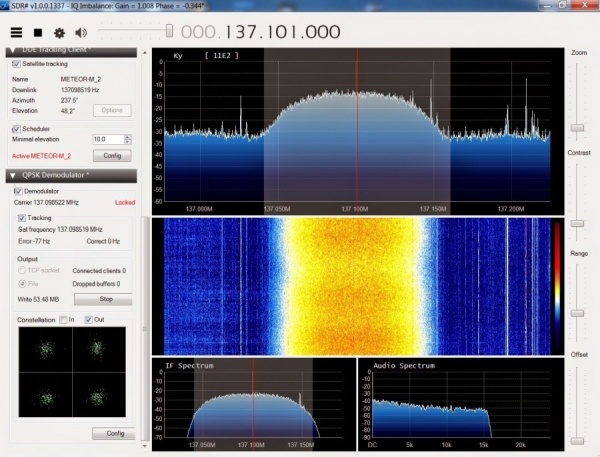
The satellite is currently active with a Low Resolution Picture Transmission (LRPT) signal which broadcasts live weather satellite images, similar to the 137 Mhz APT images produced by the US NOAA satellites. LRPT images are however much better as they are transmitted as a digital signal with an image resolution 12 times greater than the aging analog US NOAA APT signals. NOAA satellite images are grainy black and white and the color is artificial and added by the processing software. Thanks to the work of Oleg Bekrenev we now have a QPSK demodulator plugin for SDR# that allows the real time reception and decoding of Meteor-M2 LRPT images. The demodulator works very good even with weak signals, it’s capable of decode image with SNR > 5-6. Thanks to that you can receive satellite images with suboptimal antennas.
Radio enthusiast Happysat has come forth with a complete PDF tutorial which can be downloaded here . The basic steps involve setting up Orbitron tracking software and the DDE plugin to automatically track the Meteor-M2 LRPT satellite and signal, and then setting up the QPSK plugin and the new version of Lrptdecoder to talk to one another in real time via a local TCP connection. You could also check Raydel Abreu offline method tutorial or the impresive IZ5RZR step-by-step video at the end of this blog post!
Read more: Decoding Russian Meteor-M2 satellite images in real time
-
What is the main purpose of the Meteor-M N2 satellite?
Its main missions are weather forecasting, climate change monitoring, sea water monitoring/forecasting, and space weather analysis/prediction. -
At what frequency does the Meteor-M N2 transmit images?
The satellite transmits images using the digital LRPT protocol at around 137.1 MHz. -
Which type of RTL-SDR dongle is recommended for this project?
The R820T unit is generally the better choice compared to other units. -
How much better is the image resolution of Meteor-M N2 compared to US NOAA satellites?
The digital signal has an image resolution 12 times greater than the aging analog US NOAA APT signals. -
Can I use antennas other than specific 137 MHz models for reception?
Yes, almost any 2m band or 2m/70 cm dual band ham radio antenna will work good enough due to the strong signal. -
What is the minimum Signal-to-Noise Ratio required to decode images?
The demodulator is capable of decoding images with an SNR greater than 5-6. -
Which software is needed to automatically track the satellite orbit?
Orbitron tracking software combined with the DDE plugin is used to automatically track the Meteor-M2 LRPT satellite. -
How do the Lrptdecoder and QPSK plugin communicate?
They talk to one another in real time via a local TCP connection.
