
Summary of DARPA circuit smashes electronic speed record
The DARPA Terahertz Electronics program and Northrop Grumman developed the Terahertz Monolithic Integrated Circuit (TMIC), a ten-stage common-source amplifier reaching one terahertz with gains of 9 dB at 1.0 THz and 10 dB at 1.03 THz, surpassing the prior 850 GHz record. This breakthrough supports next-generation imaging, radar, spectroscopy, and communications by moving solid-state electronics beyond 300 GHz toward practical terahertz radio circuits.
Parts used in the Terahertz Monolithic Integrated Circuit (TMIC):
- Ten-stage common-source amplifier topology
- Terahertz Monolithic Integrated Circuit (TMIC) die
- High-frequency transistor devices suitable for terahertz operation
- On-chip interstage matching networks
- Power gain stages achieving 9–10 dB at around 1 THz
- Packaging and interconnects compatible with sub-millimeter wavelengths
- Supporting design work from DARPA HiFIVE, SWIFT, and TFAST programs
Getting into the Guinness Book of World Records isn’t just about who can eat the most hotdogs or fly a paper airplane the highest. Sometimes it involves technological breakthroughs with huge potential. Guinness has handed DARPA’s Terahertz Electronics program the award for the fastest solid-state amplifier integrated circuit. Developed by Northrop Grumman, the Terahertz Monolithic Integrated Circuit (TMIC) is a ten-stage common-source amplifier that cranks speeds of one terahertz (1012 Hz), or one trillion cycles per second.
DARPA argues that the current state of electronics must move beyond speeds of 300 gigahertz and wavelengths of less than a millimeter if it is to meet the needs of the next generation of imaging, radar, spectroscopy, and communications technology.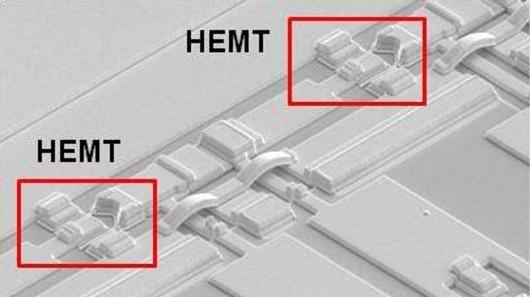
It’s all a matter of gain – a measurement of the ability of an electrical circuit to increase the power of a signal between the input and the output, measured in logarithmic decibel (dB) units. The TMIC is based on work done by DARPA’s HiFIVE, SWIFT and TFAST programs and is capable of speeds 150 billion cycles faster than the previous record set in 2012 of 850 gigahertz. It has power gains that are several orders of magnitude greater than previous circuits with a gain of nine decibels at 1.0 terahertz (THz) and 10 decibels at 1.03 THz. In comparison, a smartphone can only manage 2 GHz.
“Gains of six decibels or more start to move this research from the laboratory bench to practical applications — nine decibels of gain is unheard of at terahertz frequencies” says Dev Palmer, DARPA program manager. “This opens up new possibilities for building terahertz radio circuits.”
For more detail: DARPA circuit smashes electronic speed record
- What record did the TMIC achieve?
The TMIC set the record for the fastest solid-state amplifier integrated circuit at one terahertz. - Who developed the TMIC?
The TMIC was developed by Northrop Grumman under DARPA’s Terahertz Electronics program. - What amplifier topology does the TMIC use?
The TMIC uses a ten-stage common-source amplifier topology. - How much gain does the TMIC provide at terahertz frequencies?
The TMIC provides about nine decibels of gain at 1.0 THz and ten decibels at 1.03 THz. - How does the TMIC compare to previous speed records?
The TMIC operates 150 gigahertz faster than the prior record of 850 gigahertz set in 2012. - Why is moving beyond 300 gigahertz important?
DARPA argues moving beyond 300 GHz is necessary to meet future imaging, radar, spectroscopy, and communications needs. - What programs contributed to the TMIC development?
The TMIC builds on work from DARPA's HiFIVE, SWIFT, and TFAST programs. - What does nine decibels of gain mean for terahertz research?
The article states that gains of six decibels or more move research toward practical applications, and nine decibels is described as unheard of at terahertz frequencies, opening possibilities for terahertz radio circuits.
