
Summary of APOLLO S10 SOM
Terasic’s Apollo S10 SOM is a compact, modular Stratix 10 SoC module for scalable FPGA prototyping and HPC, offering up to 90x CPU performance for workloads like simulation, molecular dynamics, and ML. It features 2800K logic elements, up to 70% lower power, dual ECC DDR4 banks (up to 32 GB total), USB-Blaster II, FMC/FMC+ expansion, 336 FPGA I/O, 34 high-speed transceivers, and HPS interfaces including USB OTG, USB-UART, and Gigabit PHY.
Parts used in the Apollo S10 SOM:
- Terasic Apollo S10 system on module (SOM)
- Intel Stratix 10 SX FPGA with 2800 K logic elements
- On-board USB-Blaster II
- EPCQ or microSD card for booting
- Two independent DDR4 memory banks with ECC (up to 16 GB each)
- FMC+ connector
- FMC connector
- High-speed transceivers (34)
- Support for 336 FPGA I/O
- USB 2.0 OTG interface
- USB to UART interface
- Gigabit PHY interface for HPS communication
Terasic’s Apollo S10 SOM for scalable FPGA prototyping and HPC solutions which provide up to 90x performance increase over CPUs for critical workloads.
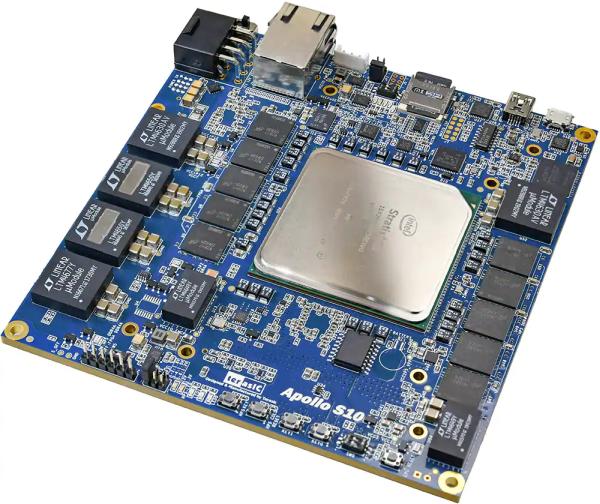
Terasic’s Apollo S10 system on module (SOM) is designed for modular and scalable high-performance FPGA prototyping and high-performance computing (HPC) solutions. The Apollo S10 SOM packs unbeatable performance and energy efficiency into a tiny form factor. It provides up to 90x performance increase over CPUs for critical workloads such as simulation acceleration, molecular dynamics, and machine learning.
Apollo S10 SOM takes advantage of the latest Intel® Stratix® 10 SoC with 2800 K logic elements to obtain speed and power breakthrough (with up to 70% lower power). Combining several high-end hardware interfaces, such as high-capacity and high-bandwidth DDR4 SDRAM (up to 32 GB), on-board USB-Blaster™ II, and FMC/FMC+ connectors for I/O expansion, the board delivers more than 2x the performance of previous-generation development kits.
Features
- Apollo S10 module board
- Stratix 10 SX FPGA with 2800 K logic elements
- Core speed grade: -2
- Transceiver speed grade: -1On-board USB-Blaster II for programming Stratix 10 and EPCQ/microSD™ card for booting device
- Stratix 10 SX FPGA with 2800 K logic elements
- Two independent banks of DDR4 on-board memory with error correction code (ECC), up to 16 GB at 1066 MHz for each bank
- FMC+ and FMC connectors for interface expansionSupport 336 FPGA I/O
- 34 high speed transceivers
- Support USB 2.0 OTG, USB to UART, and Gigabit PHY interface for HPS communication
Read more: APOLLO S10 SOM
- What performance improvement does the Apollo S10 SOM provide over CPUs?
The article states it can provide up to 90x performance increase over CPUs for critical workloads. - Which FPGA is used on the Apollo S10 SOM?
It uses the Intel Stratix 10 SX FPGA with 2800 K logic elements. - How much DDR4 memory does the Apollo S10 SOM support?
It supports two independent DDR4 banks with ECC, up to 16 GB per bank, totaling up to 32 GB. - Does the Apollo S10 SOM include a programming/debug interface?
Yes, it includes an on-board USB-Blaster II for programming Stratix 10. - What expansion options are available for I/O on the Apollo S10 SOM?
It provides FMC and FMC+ connectors for interface expansion and supports 336 FPGA I/O. - How many high-speed transceivers does the Apollo S10 SOM support?
The module supports 34 high-speed transceivers. - What HPS communication interfaces are supported?
It supports USB 2.0 OTG, USB to UART, and a Gigabit PHY interface for HPS communication. - Does the Apollo S10 SOM offer power efficiency benefits?
The article claims up to 70% lower power compared with prior solutions.
