
Summary of CONGATEC ANNOUNCES A COM EXPRESS TYPE 7 MODULES FOR THE AIRCRAFT INDUSTRY
Congatec launched two Type 7 COM Express modules, the Conga-B7XD and Conga-B7AC, designed for aircraft edge servers. These modules support up to 96GB DDR4 memory and offer enhanced Linux and Windows compatibility. Built for high performance in augmented reality, AI assistants, and video surveillance, they feature robust durability against extreme temperatures (-40°C to 85°C) and vibrations, ensuring reliability in sophisticated cockpit environments.
Parts used in the Congatec Type 7 Modules:
- Conga-B7XD module with Intel Xeon D 15xx processor
- Conga-B7AC module with Intel Atom C3xxx processor
- DDR4 SODIMMs (up to 96GB via 3x 32GB sockets)
- Windows-supported software version
- Linux-supported software version
- Vibration and shockproof materials
A new milestone is hit by Congatec, as they recently announced Type 7 modules. Congatec has struggled hard to take Linux friendliness to the very next level and to make server response to quickest possible till date. To do that, two Type 7 modules are introduced to the market which provide support of up to 96GB DDR4 and designed for converged edge servers in aircraft.
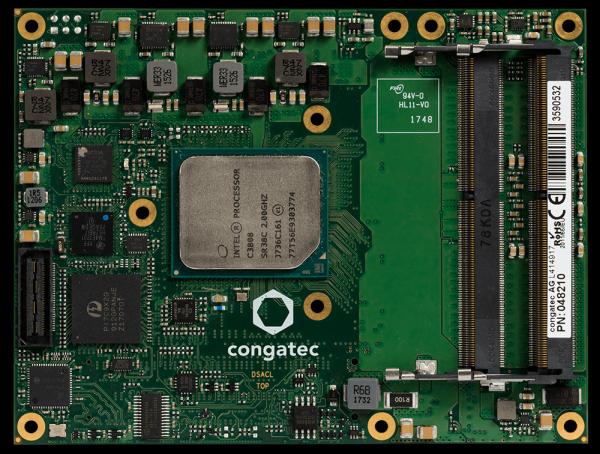
The two modules introduced are:
- Conga-B7XD – Intel Xeon D and Pentium D based Conga-B7XD
- Conga-B7AC – Intel Atom C3xxx based Conga-B7AC
Congatec has not competed for COM express in the past. But the game is interesting now, as they got themselves prepare for the race. That’s good for inventions. To cope up with the market, they also introduced a Windowssupported version of type 7 module, in addition to the Linux. These are specially designed to run in aircraft computers, to make them extra efficient.
Conga-B7XD & Conga-B7AC COMs
Conga-B7XD board is the first one we will take a look and uses a Xeon D 15xx based core. While, Conga-B7AC, the second one is an Atom C3xxx based. It has an inbuilt memory of DDR4 type, ranging up to 96 GB DDR4 SODIMMs which are available via 3x 32GB-ready sockets. The 12 virtual machines on the system now can use 8GB RAM on each partition.
These new set of modules will excel in applications like augmented reality, airborne platforms for connected aircraft, passenger infotainment, Big Data applications, video surveillance, cloud-based flight data recordings, AI-based virtual assistants for improving pilot productivity and efficiency, and similar because of their demand for higher performance and memory, which is something the new Congatec easily cater for.
Due to its use in highly sophisticated devices, like the cockpit and streaming devices, their durability for temperature ranges and vibrations have builtin. Temperature range is matched from 0 to 60°C or an industrial -40 to 85°C, depending on the processor type. While hard sort of vibration and shockproof material is used, all of this together makes it a powerful device to have.
Read more: CONGATEC ANNOUNCES A COM EXPRESS TYPE 7 MODULES FOR THE AIRCRAFT INDUSTRY
- What new modules did Congatec introduce?
Congatec introduced the Conga-B7XD and Conga-B7AC Type 7 modules. - How much memory do these modules support?
The modules support up to 96GB of DDR4 memory using three 32GB-ready sockets. - Can these modules run Windows?
Yes, a Windows-supported version is available alongside the Linux version. - Which processors are used in the Conga-B7XD?
The Conga-B7XD uses an Intel Xeon D 15xx based core. - What is the operating temperature range for these devices?
The temperature range matches 0 to 60°C or industrial -40 to 85°C depending on the processor. - Are these modules suitable for aircraft computers?
Yes, they are specially designed to run efficiently in aircraft computers. - Does the system support virtual machines?
The system can run 12 virtual machines with 8GB RAM allocated to each partition. - What applications benefit from these modules?
Applications include augmented reality, passenger infotainment, video surveillance, and AI-based virtual assistants.
