
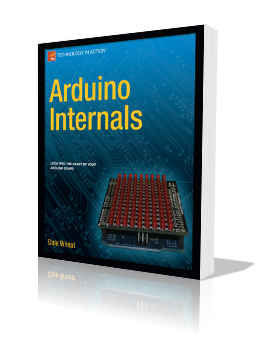
Summary of Arduino Internals by Dale Wheat E-Book
Arduino Internals by Dale Wheat explores the Arduino board's hardware and software, explaining the ATmega8 architecture, CPU, memory, peripherals, and toolchain. It teaches building and improving Arduino boards, designing shields and peripherals, optimizing code and libraries, and alternative toolchains and programming environments. The book includes collaboration practices, communication protocols, example projects, and integrated challenges to apply learned skills.
Parts used in the Arduino Internals Project:
- Arduino board (ATmega8 and derivatives)
- ATmega series CPU
- On-board memory (flash, SRAM, EEPROM)
- Peripherals (GPIO, timers, ADC, communication interfaces)
- Shields and peripherals for Arduino
- Compiler toolchain (Arduino toolchain and alternatives)
- Libraries for Arduino
- Supporting hardware components for custom boards
- Networking and communication modules/protocols
Arduino Internals guides you to the heart of the Arduino board. Author Dale Wheat shares his intimate knowledge of the Arduino board—its secrets, its strengths and possible alternatives to its constituent parts are laid open to scrutiny in this book. You’ll learn to build new, improved Arduino boards and peripherals, while conforming to the Arduino reference design.
One of the crowning achievements of an Arduino hacker is to design a shield or peripheral residing on the Arduino board, which is the focus of the following chapter. A later chapter takes specialization further by examining Arduino protocols and communications, a field immediately relevant to shields and the communication between peripherals and the board.
Finally, Arduino Internals integrates different skills and design techniques by presenting several projects that challenge you to put your newly-acquired skills to the test!
Please note: the print version of this title is black & white; the eBook is full color.
What you’ll learn
- To understand the internal heart of your Arduino board
- How to replace parts of the Arduino board with new, more powerful elements
- How to build a new Arduino board
- How to build your own peripherals and shields
- How to optimize your own code and existing libraries to run on your own Arduino device
Who this book is for
This book is geared towards intermediate-level Arduino hackers and makers, embedded system designers who want to know what Arduino is about, hardware designers who would like to change Arduino to suit their own requirements, and developers who would like to write optimized Arduino software.
Table of Contents
-
Hardware
-
Software
-
Atmel AVR
-
Supporting Hardware
-
Arduino Software
-
Optimizations
-
Hardware and Software Combined
-
Example Projects
-
Project Management
-
Hardware Design
-
Software Design
-
Networking
-
Tabletop Robot Project
Link to Purchase E-Book:
Arduino Internals by Dale Wheat E-Book
- What does Arduino Internals teach about the ATmega8 board?
It offers a clear analysis of how the ATmega8 board works and when and where to use its derivatives. - Can I learn to build a new Arduino board from this book?
Yes, the book teaches how to build a new, improved Arduino board while conforming to the Arduino reference design. - Does the book cover how to design shields and peripherals?
Yes, there is a chapter focused on designing shields and peripherals for the Arduino board. - How does the book address software optimization?
It includes chapters on optimizing hardware-software interaction and optimizing code and libraries to run on Arduino devices. - Are alternative toolchains and programming environments discussed?
Yes, the author analyzes the compiler toolchain and suggests how to replace it and presents alternative programming environments. - Does Arduino Internals include example projects?
Yes, the book uses example projects to demonstrate hacks, algorithms, and integrates skills with several challenge projects. - Who is the intended audience for this book?
Intermediate-level Arduino hackers, embedded system designers, hardware designers, and developers wanting optimized Arduino software. - Does the book cover collaboration and open source cooperation?
Yes, there is a whole chapter dedicated to collaboration and open source cooperation. - Are communications and networking topics included?
Yes, a chapter examines Arduino protocols and communications relevant to shields and peripherals.
