
Summary of Arduino Based Temp and Humidity Display
The author builds a custom temperature and humidity display to monitor office conditions, preferring the educational value over buying a cheap thermometer. Using an Arduino-based system with a DHT22 sensor and 7-segment display, the project involves designing the circuit layout in Fritzing and programming the ATMEGA328P microcontroller. The build aims to provide precise environmental readings while offering a unique, "cooler" alternative to commercial devices.
Parts used in the Arduino Based Temp and Humidity Display:
- DHT22 Temperature-Humidity Sensor + Extras (Aosong AM2302 + 10k 5% resister)
- Adafruit Perma-Proto Half-Sized
- Adafruit 0.56 inch 4-Digit 7-Segement Display w/I2C Backpack
- TE/Amp 28pin DIP Socket 1-390261-9 (optional)
- Molex 90 Degree 0.1 inch Header 1x6 22-28-8102
- 10k Ohm 5% Resister
- 5v Power Supply
- 2 x 0.1uF Ceramic Capacitor
- 2 x 22pF Ceramic Capacitor
- 16 Mhz Crystal Oscillator
- 2.1mm DC Barrel Jack
- Solid Core Wire
- Atmel ATMEGA328P-PU or Adafruit Atmel ATMega328P-PU (pre-programed w/Arduino bootloader)
The temperature in my office at work varies quite a bit depending on the time of day, season, and the whims of the other people I share the floor with. When I’m sitting at my desk shaking uncontrollably or sweating profusely it would be nice to know if it’s due to the temperature or just work related stress. A simple $5.00 thermometer would suffice, but where’s the fun in that? Making my own thermometer might cost ten times as much, but I might learn something in the process and it would be way cooler than any cheap store bought thing? I’d rather make something myself even if I have to pay a “maker’s premium.”
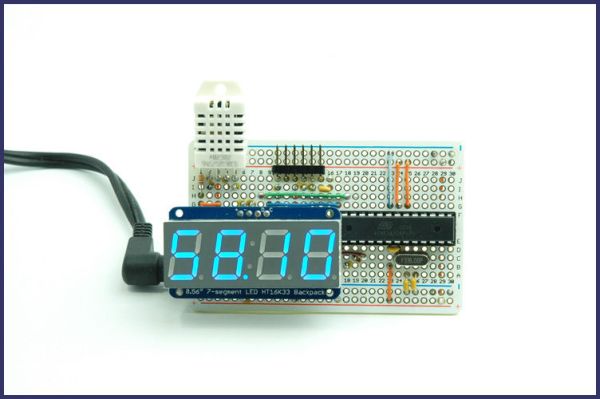
Step 1: BOM
Bill of Materials:
DHT22 Temperature-Humidity Sensor + Extras (Aosong AM2302 + 10k 5% resister)
Adafruit Perma-Proto Half-Sized
Adafruit 0.56” 4-Digit 7-Segement Display w/I2C Backpack
TE/Amp 28pin DIP Socket 1-390261-9 (optional)
Molex 90 Degree 0.1” Header 1×6 22-28-8102
10k Ohm 5% Resister
5v Power Supply
2 x 0.1uF Ceramic Capacitor
2 x 22pF Ceramic Capacitor
16 Mhz Crystal Oscillator
2.1mm DC Barrel Jack
Solid Core Wire
Atmel ATMEGA328P-PU or Adafruit Atmel ATMega328P-PU (pre-programed w/Arduino bootloader)
Tools:
Soldering Iron
Solder
Adafruit Standalone AVR ISP Programmer Shield (or any other programmer for burning bootloaders to AVRs)
FTDI USB Adaptor or FTDI USB Cable
Step 2: Design
The first thing to do is layout the placement of devices on the Perma-Proto board. This was the first time I’ve used Fritzing. Fritzing is an open-source electronics design application available for Windows, Mac OSX, and Linux. I chose to try it out on this project because I knew that Adafruit had a large Fritzing library of parts that included the Perma-Proto board. The software makes the layout of parts and connections on the Perma-Proto a snap. The Fritzing file can be downloaded along with the Arduino sketch from GitHub.
For more detail: Arduino Based Temp and Humidity Display
- What is the primary purpose of this project?
To monitor office temperature and humidity variations instead of using a simple store-bought thermometer. - Which software was used to design the circuit layout?
Fritzing, an open-source electronics design application available for Windows, Mac OSX, and Linux. - Can I download the Fritzing file for this project?
Yes, the Fritzing file can be downloaded along with the Arduino sketch from GitHub. - What microcontroller is required for this build?
An Atmel ATMEGA328P-PU or Adafruit Atmel ATMega328P-PU pre-programmed with an Arduino bootloader. - What tools are needed to burn bootloaders to AVRs?
An Adafruit Standalone AVR ISP Programmer Shield or any other programmer capable of burning bootloaders. - Is a specific resistor included in the Bill of Materials?
Yes, a 10k Ohm 5% Resister is listed as a necessary component. - What type of power supply does the project require?
The project requires a 5v Power Supply connected via a 2.1mm DC Barrel Jack. - Does the project use ceramic capacitors?
Yes, it uses two 0.1uF Ceramic Capacitors and two 22pF Ceramic Capacitors.
