
Summary of ALL-MECHANICAL COIL WINDER IS A SCRAP-BIN DELIGHT
Ralph (VK3ZZC) built an all-mechanical coil winder inspired by the MoReCo Coilmaster using scrap metal and basic tooling. A hand crank drives the winding shaft and a cam-driven guide for different winding patterns; interchangeable chucks accept various coil forms. A beeswax reservoir coats the wire for lubrication and tackiness. The contraption replicates commercial functionality without motors or electronics, showcasing clever mechanical design and practical details like changeable cams and wire-waxing from simple materials.
Parts used in the All-Mechanical Coil Winder:
- Hand crank
- Main winding shaft
- Cam mechanism for axial wire guidance
- Interchangeable cams
- Various chucks for coil forms
- Wire feed tube
- Beeswax reservoir attached to the feed tube
- Scrap brass and steel structural components
- Drill press used as tooling during construction
If there’s something more tedious than winding coils, we’re not sure what it is — possibly rolling and wrapping coins; that’s really a bother. But luckily, just like there are mechanical ways to count coins, there are tools to make coil production a little less of a chore, but perhaps none that have as much charm as this all-mechanical coil winder.
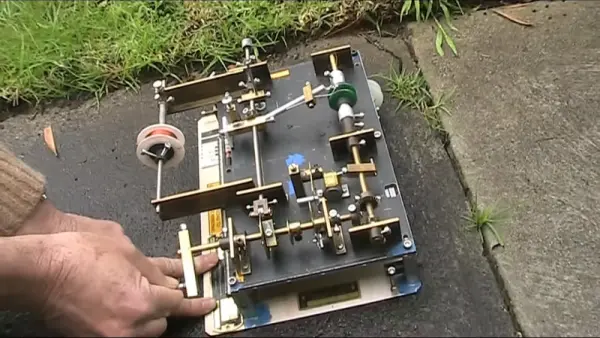
We’d say that [Ralph (VK3ZZC)]’s amazing invention firmly falls under the “contraption” category, without a hint of the term being used as a pejorative. The rig was based on the MoReCo Coilmaster, a machine that was once commercially available at a fairly steep price, according to [Ralph], and still seems to command a premium even today. Never being able to afford an original, [Ralph] spun up his own from scrap metal and tooling no more sophisticated than a drill press. It’s a riot of brass and steel, with a hand crank that drives the main winding shaft while powering a cam that guides the wire along the long axis of the coil form. Cams can be changed out for different winding patterns, and various chucks adapt to hold different coil forms to the winding shaft.
There are a ton of interesting details in the build, which [Ralph] explains over on fellow ham [Peter (VK3YE)]’s YouTube channel — video below. The neatest idea is a reservoir attached to the wire feed tube that holds beeswax. The wire gets coated with wax as it feeds out to the coil, serving not only to lubricate things a bit but also to provide some tackiness to encourage the magnet wire to stay in place on the coil form. It’s a lovely detail, although [Ralph]’s source for the wax — the coating from a block of cheese — isn’t exactly appetizing.
We’ve seen coil winders before, but most of them are motorized and Arduino-fied affairs. Not that there’s anything wrong with that, but seeing an all-mechanical solution in action is pretty cool too.
Source: ALL-MECHANICAL COIL WINDER IS A SCRAP-BIN DELIGHT
- What inspired the design of this coil winder?
The rig was based on the MoReCo Coilmaster and built because the original was unaffordable. - Can the winding pattern be changed?
Yes, cams can be changed out for different winding patterns. - How is the wire guided along the coil form?
A cam drives a guide that moves the wire along the long axis of the coil form. - Does the winder use electricity or motors?
No, it is an all-mechanical device driven by a hand crank. - How does the wire stay in place on the coil form?
The wire is coated with beeswax from a reservoir to lubricate and provide tackiness so the magnet wire stays in place. - What materials were used to build the winder?
It was constructed from scrap metal including brass and steel using simple tooling like a drill press. - Can different coil form sizes be accommodated?
Yes, various chucks adapt to hold different coil forms to the winding shaft. - Was any unusual source used for the wax?
Yes, the article notes a source of wax as the coating from a block of cheese.
