
Summary of ADI aims ECG chip at consumer health monitors
The AD8232 is an integrated, low-power single-lead ECG front end that extracts, amplifies, and filters small biopotential signals for wearable and remote health monitors. It combines a two-pole high-pass filter with an instrumentation amplifier, offers an uncommitted op amp for multi-pole low-pass filtering, includes driven-lead (RLD), fast restore, leads-off detect, and selectable filter cutoffs, and is available in a 4 mm × 4 mm, 20-lead LFCSP with operation from −40°C to +85°C.
Parts used in the AD8232 Project:
- AD8232 integrated signal conditioning AFE (4 mm × 4 mm, 20-lead LFCSP)
- Uncommitted operational amplifier (internal to AD8232)
- Two-pole high-pass filter (implemented within AD8232)
- Three-pole low-pass filter (implemented using uncommitted op amp)
- Right leg drive (RLD) amplifier (internal to AD8232)
- Reference buffer (internal to AD8232)
- Leads-off detect circuitry (AC or DC selectable, internal to AD8232)
- External electrodes (for two or three electrode configurations)
- Ultralow power ADC or embedded microcontroller (for signal acquisition)
- Power supply compatible with 170 μA typical supply current
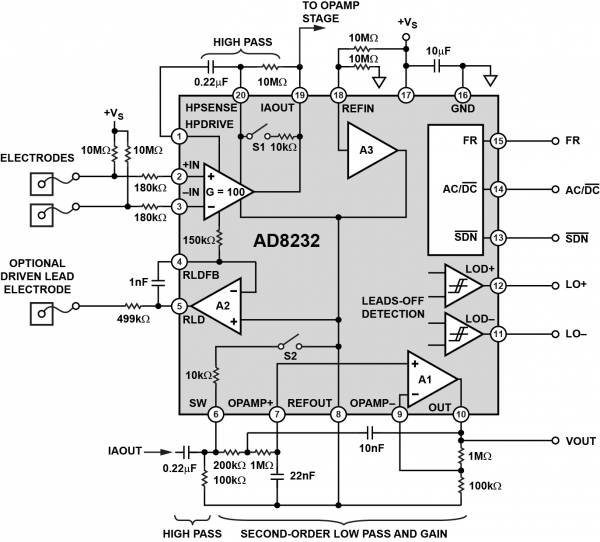
The AD8232 is an integrated signal conditioning block for ECG and other biopotential measurement applications. It is designed to extract, amplify, and filter small biopotential signals in the presence of noisy conditions, such as those created by motion or remote electrode placement. This design allows for an ultralow power analog-to-digital converter (ADC) or an embedded microcontroller to acquire the output signal easily.
The AD8232 can implement a two-pole high-pass filter for eliminating motion artifacts and the electrode half-cell potential. This filter is tightly coupled with the instrumentation architec-ture of the amplifier to allow both large gain and high-pass filtering in a single stage, thereby saving space and cost.
An uncommitted operational amplifier enables the AD8232 to create a three-pole low-pass filter to remove additional noise. The user can select the frequency cutoff of all filters to suit different types of applications.
To improve common-mode rejection of the line frequencies in the system and other undesired interferences, the AD8232 includes an amplifier for driven lead applications, such as right leg drive (RLD).
The AD8232 includes a fast restore function that reduces the duration of otherwise long settling tails of the high-pass filters. After an abrupt signal change that rails the amplifier (such as a leads off condition), the AD8232 automatically adjusts to a higher filter cutoff. This feature allows the AD8232 to recover quickly, and therefore, to take valid measurements soon after connecting the electrodes to the subject.
The AD8232 is available in a 4 mm × 4 mm, 20-lead LFCSP package. Performance is specified from 0°C to 70°C and is operational from −40°C to +85°C.
FEATURES and BENEFITS
- Fully integrated single-lead ECG front end
- Low supply current:
- 170 μA (typical)
- Common-mode rejection ratio: 80 dB (dc to 60 Hz)
- Two or three electrode configurations
- High signal gain (G = 100) with dc blocking capabilities
- 2-pole adjustable high-pass filter
- Accepts up to ±300 mV of half cell potential
- Fast restore feature improves filter settling
- Uncommitted op amp
- See data sheet for additional features
Analog Devices is targeting consumer body monitor designs with a heart-rate monitor analogue front end (AFE).
The AD8232 AFE is designed to meet the ECG signal conditioning requirements of emerging fitness, portable/wearable monitoring and remote health monitoring equipment.
“The intention has been to create a device which supports a range of heart rate and ECG monitoring applications ranging from consumer style fitness monitors to remote health management devices,” Jan-Hein Broeders of Analog Devices told Electronics Weekly.
A feature of the front-end chip is its two-pole, high-pass filter that is tightly coupled with the IC’s instrumentation amplifier architecture, and an uncommitted operational (gain) amplifier that enables the user to employ multi-pole low pass filtering techniques to remove line noise and other interference.
There is a reference buffer, right leg drive circuit and shutdown function.
The AD8232 also includes user-selectable (AC or DC) leads-off detect circuitry that monitors when an electrode is disconnected from the patient or user, providing an alert to the system.
For more read: ADI aims ECG chip at consumer health monitors
- What is the AD8232 used for?
The AD8232 is used as an integrated signal conditioning front end for single-lead ECG and other biopotential measurement applications. - Can the AD8232 filter motion artifacts?
Yes, the AD8232 implements a two-pole high-pass filter to eliminate motion artifacts and electrode half-cell potential. - Does the AD8232 include a low-pass filter?
An uncommitted operational amplifier in the AD8232 enables creation of a three-pole low-pass filter to remove additional noise. - How does the AD8232 improve common-mode rejection?
The AD8232 includes a driven lead amplifier, such as right leg drive, to improve common-mode rejection of line frequencies and interference. - What is the fast restore feature?
The fast restore function reduces settling tails of the high-pass filters by automatically adjusting to a higher cutoff after abrupt signal changes, allowing quick recovery. - Can the AD8232 detect disconnected electrodes?
Yes, it includes user-selectable AC or DC leads-off detect circuitry that alerts when an electrode is disconnected. - What package and temperature range is the AD8232 available in?
It is available in a 4 mm × 4 mm, 20-lead LFCSP; performance is specified from 0°C to 70°C and operational from −40°C to +85°C. - What is the typical supply current of the AD8232?
The AD8232 has a typical supply current of 170 μA. - What electrode configurations does the AD8232 support?
The AD8232 supports two or three electrode configurations.
