
Summary of A SMART RADAR SYSTEM FOR GESTURE RECOGNITION AND NON-CONTACT VITAL SIGNS MONITORING.
Imec presents a compact 140GHz MIMO radar system enhanced with machine learning for gesture recognition and vital sign monitoring. Operating up to 10 meters with 15mm resolution, the prototype uses on-chip antennas in 28nm CMOS technology. It enables intuitive human-machine interactions in AR/VR while preserving privacy and functioning independently of lighting conditions.
Parts used in the imec 140GHz Radar System:
- 140GHz radar-on-chip prototype
- MIMO (multiple-input multiple-output) setup
- Transceiver chip with on-chip antennas
- 28nm bulk CMOS technology
- Virtual 1×4 MIMO configuration
- Machine learning algorithms
Imec adds machine learning to its 140GHz radar technology to enable intuitive man-machine interactions
This week, at FutureSummits 2019, imec, a world-leading research and innovation hub in nanoelectronics and digital technologies, presents a compact highly-sensitive 140GHz MIMO (multiple-input multiple-output) radar system. The MIMO setup is demonstrated for gesture recognition, supporting intuitive man-machine interactions. In addition, the ultra-fine resolution of this radar allows the detection micro-skin movements related to vital signs serving applications like non-contact driver monitoring or patient monitoring.
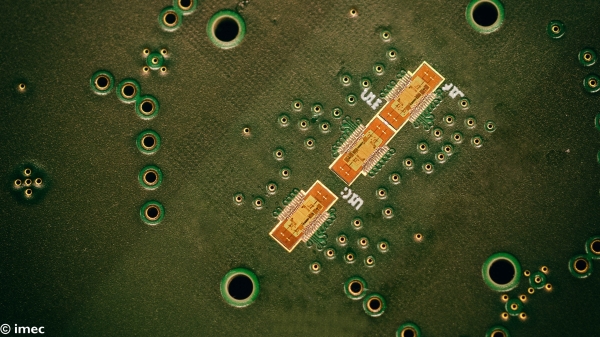
Key differentiators of imec’s 140GHz radar-on-chip prototype system are its small size and high radar performance – in terms of resolution and motion sensitivity. The radar operates up to 10m range, with 15mm range resolution and 10GHz of RF bandwidth. Multiple antenna paths are incorporated to enable a complete (virtual) 1×4 MIMO configuration to achieve angular target separation. The transceiver chip features on-chip antennas, and are integrated in 28nm bulk CMOS technology, ensuring a low-cost solution at high volume production. These properties make the radar system particularly appealing for applications where high-precision, small-motion based detection is key.
By adding machine learning capabilities, imec has now demonstrated the feasibility of the radar to detect and classify small motions based on Doppler information.
“This opens new opportunities, for example, enabling gesture recognition for intuitive man-machine interactions”, adds Barend van Liempd, R&D manager at imec. “Think about the AR/VR space, where the new radar can support intuitive interaction with virtual objects. Gesture recognition can potentially also enable intuitive device control – complementary to existing interfaces such as voice control or smart touch screens.”
Being insensitive to lighting conditions and preserving privacy (a radar can so far not recognize humans), a radar solution has particular advantages over other types of motion sensors, for example time-of-flight-based infrared cameras. And, being extremely compact, imec’s 140GHz radar system can be integrated invisibly in almost every device, such as laptops, smartphones or screen bezels.
Read more: A SMART RADAR SYSTEM FOR GESTURE RECOGNITION AND NON-CONTACT VITAL SIGNS MONITORING.
- What is the primary function of imec's new radar system?
The system detects and classifies small motions for gesture recognition and non-contact vital signs monitoring. - How does machine learning improve this radar technology?
It enables the radar to detect and classify small motions based on Doppler information. - What range and resolution does the radar achieve?
It operates up to a 10m range with a 15mm range resolution. - Can this radar be used in low-light environments?
Yes, it is insensitive to lighting conditions unlike time-of-flight-based infrared cameras. - Does the radar preserve user privacy?
Yes, it cannot recognize humans, making it advantageous over other motion sensors. - What technology is used to manufacture the transceiver chip?
The chip is integrated in 28nm bulk CMOS technology. - How many antenna paths are incorporated for angular separation?
Multiple antenna paths enable a complete virtual 1×4 MIMO configuration. - What are potential applications mentioned for this device?
Applications include AR/VR interaction, device control, driver monitoring, and patient monitoring.
