
Summary of SiTime enters wearables, IoT markets with 32 kHz MEMS TCXO
SiTime's new SiT1552 MEMS TCXO is the industry's smallest and lowest-power 32 kHz oscillator, designed for wearables and IoT. It utilizes TempFlat MEMS technology to achieve +/- 5 ppm stability over temperature, offering a 20% size reduction and 50% lower power consumption compared to legacy quartz devices. Its compact 1.5 x 0.8 mm chip scale package supports functions like RTC references, sleep clocks for connectivity, and battery supervisory heartbeat clocks, significantly extending battery life by minimizing early on-time penalties in Bluetooth Low Energy standards.
Parts used in the SiT1552 MEMS TCXO Project:
- SiT1552 MEMS TCXO
- TempFlat MEMS Technology
- Analog Technology
- SiT153x (Previous Solution Reference)
- 1.5 x 0.8 mm Chip Scale Package (CSP)
- Real Time Clock (RTC) Function
- Bluetooth Connectivity Module
- WiFi Connectivity Module
- Battery Supervisory Function
I recently spoke to Piyush Sevalia, Executive Vice President, Marketing at SiTime Corporation,about their newly introduced 32 kHz TCXO (temperature compensated oscillator) which they claim to be the smallest, lowest power device in the industry. With its tiny footprint and ultra-low power consumption, the SiT1552 MEMS TCXO decreases the size and increases battery life of wearable electronics and Internet of Things (IoT); such benefits are not achievable from legacy quartz devices.
The company uses its TempFlat MEMSTM (See my article on SiTime’s MEMS Resonators: An alternative to Quartz) and analog technology to attain some really excellent specifications. The SiT1552 MEMS TCXO is 20% of the size and consumes 50% of the power of comparable quartz devices. See Figure 1 for the architectural diagram of this device.
Stability over temperature
Here is the amazing accomplishment in this device. The previous solution which is still a good solution for many designs is the SiT153x, a 32 kHz XO @ 100 ppm stability—this device is great for the mobile and tablet market. The newer device SiT1552, a 32 kHz TCXO has +/- 5 ppm stability—-wearables, sport fitness, personal medical devices, accessories and the IoT and are the market for this device where ultimate accuracy, increased battery life and small size are critical. See Figure 2.
Figure 2: The SiT153x frequency stability over temperature vs. the SiT1552
The following video tells the complete story about this device:
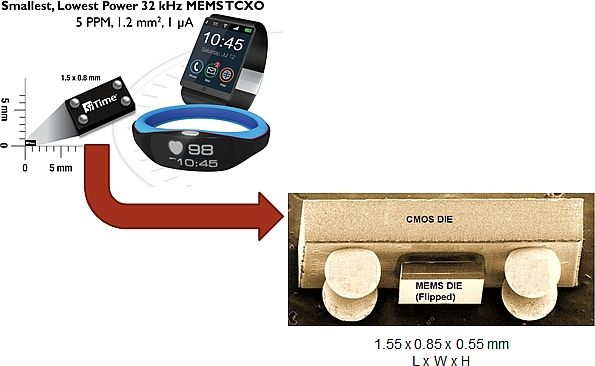
The device is available in a 1.5 x 0.8 mm chip scale package (CSP). See Figure 3.
Figure 3: Showing the unique packaging to obtain the smallest size possible
The device can perform various functions in a system such as:
- Reference for real time clock (RTC) function
- Sleep clock for connectivity – Bluetooth, Bluetooth Low Energy, WiFi
- Heartbeat clock for battery supervisory function
Extending battery life
Now we get to one of the most important aspects of this design—extending battery life of the device in which it will reside. This is what really blew my mind. Here is how it does just that:
- Problem: Frequent network connections consume power, limits battery life.
- Solution: 5 PPM 32kHz sleep-clock maximizes battery life
- On Time and Sleep Time are defined in BLE standards
- Early On Time is penalty due to clock inaccuracy (worse stability)
- Tighter Stability à Shorter Early On Time à Lower Power
For more detail: SiTime enters wearables, IoT markets with 32 kHz MEMS TCXO
- What makes the SiT1552 unique compared to legacy quartz devices?
The SiT1552 is 20% smaller and consumes 50% less power than comparable quartz devices. - How does the SiT1552 improve battery life in wearable electronics?
Tighter frequency stability reduces Early On Time penalties in BLE standards, resulting in lower power consumption. - What is the frequency stability of the SiT1552 over temperature?
The device offers +/- 5 ppm stability over temperature. - What packaging size does the SiT1552 utilize?
The device is available in a 1.5 x 0.8 mm chip scale package. - Can the SiT1552 be used as a reference for real time clock functions?
Yes, the device can serve as a reference for real time clock functions within a system. - Does the SiT1552 support sleep clock functions for connectivity?
Yes, it provides a sleep clock for Bluetooth, Bluetooth Low Energy, and WiFi connectivity. - What market segments benefit most from the SiT1552 features?
Wearables, sport fitness, personal medical devices, accessories, and the Internet of Things are the primary markets. - How does the SiT1552 compare to the previous SiT153x solution?
The SiT1552 offers superior +/- 5 ppm stability compared to the SiT153x which has 100 ppm stability.
