
Summary of LISP RUNS THIS MICROCONTROLLER PENDANT
This article describes a star-shaped pendant project where an ATtiny3227 microcontroller, powered by a coin cell battery, drives six LEDs. The unique feature is running uLisp, a custom integer-based Lisp interpreter, on the chip to control the lights. This demonstrates the flexibility of Lisp for creating new syntax and adapting to constrained hardware environments, despite pushing the microcontroller's memory and processing limits.
Parts used in the Star Pendant Project:
- Six LEDs
- ATtiny3227 microcontroller
- Coin cell battery
- uLisp (custom-built integer version of a Lisp interpreter)
As a programming language, Lisp has been around longer than any other active language except for Fortran. To anyone who regularly uses it, it’s easy to see why: the language allows for new syntax and macros to be created fluidly, which makes it easy to adapt it to new situations, like running it on a modern Atmel microcontroller to control the LEDs on this star pendant.
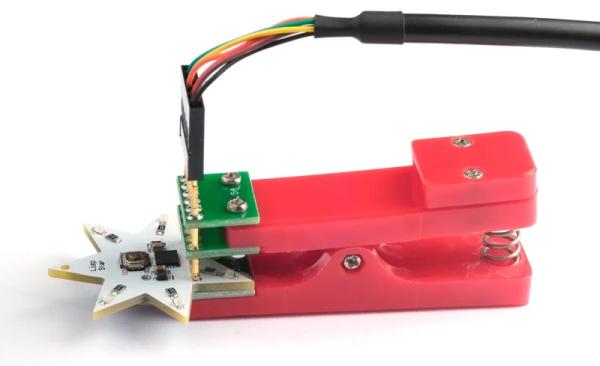
The pendant has simple enough hardware — six LEDs arranged around the points of the star, all being driven by a small ATtiny3227 operating from a coin cell battery. This isn’t especially spectacular on it’s own, but this particular microcontroller is running an integer version of a custom-built Lisp interpreter called uLisp. The project’s creator did this simply because of the whimsy involved in running a high-level programming language on one of the smallest microcontrollers around that would actually support the limited functionality of this version of Lisp. This implementation does stretch the memory and processing capabilities of the microcontroller quite a bit, but with some concessions, it’s able to run everything without issue.
As far as this project goes, it’s impressive if for nothing other than the ‘I climbed the mountain because it was there’ attitude. We appreciate all kinds of projects in that same vein, like this Arduino competitor which supports a programming language with only eight commands, or this drone which can carry a human.
Source: LISP RUNS THIS MICROCONTROLLER PENDANT
- What microcontroller powers the star pendant?
The project uses a small ATtiny3227 operating from a coin cell battery. - How many LEDs are arranged on the pendant?
There are six LEDs arranged around the points of the star. - Can Lisp be adapted to run on modern microcontrollers?
Yes, the language allows for new syntax and macros to be created fluidly to adapt to new situations. - What specific version of Lisp runs on this project?
An integer version of a custom-built Lisp interpreter called uLisp runs on the microcontroller. - Does running Lisp stretch the capabilities of the microcontroller?
Yes, this implementation stretches the memory and processing capabilities of the microcontroller quite a bit. - Why did the creator choose to run Lisp on such a small chip?
The creator did this simply because of the whimsy involved in running a high-level programming language on one of the smallest microcontrollers. - Does the project require concessions to function correctly?
Yes, with some concessions, the system is able to run everything without issue. - Is Fortran older than Lisp among active languages?
Lisp has been around longer than any other active language except for Fortran.
