
Summary of THE FASTEST FOURIER TRANSFORM IN THE WEST
This article details [klafyvel]'s optimization of Fast Fourier Transforms (FFTs) for the Arduino Uno. By exploring mathematical trade-offs and low-level programming, they developed four distinct algorithms balancing speed, accuracy, code size, and array usage. The project includes techniques for float approximation, trigonometric identity optimization, overflow handling, and data gathering via Julia, significantly improving upon previous solutions while remaining resource-efficient for microcontrollers.
Parts used in the FFT Optimization Project:
- Arduino Uno
- Julia programming language
- GitHub repository
- Fourier Transform algorithm
- Fast Fourier Transform (FFT) approximations
An interesting aspect of time-varying waveforms is that by using a trick called a Fourier Transform (FT), they can be represented as the sum of their underlying frequencies. This mathematical insight is extremely helpful when processing signals digitally, and allows a simpler way to implement frequency-dependent filtration in a digital system. [klafyvel] needed this capability for a project, so started researching the best method that would fit into an Arduino Uno. In an effort to understand exactly what was going on they have significantly improved on the code size, execution time and accuracy of the previous crown-wearer.
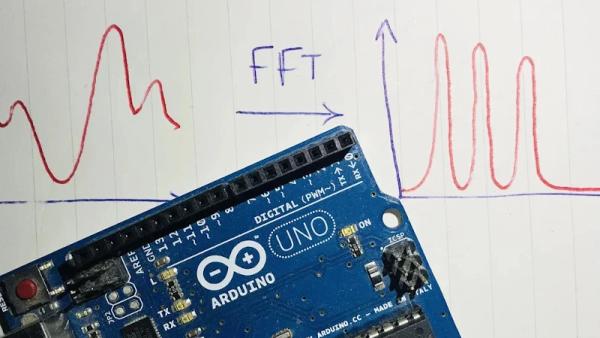
A complete real-time Fourier Transform is a resource-heavy operation that needs more than an Arduino Uno can offer, so faster approximations have been developed over the years that exchange absolute precision for speed and size. These are known as Fast Fourier Transforms (FFTs). [klafyvel] set upon diving deep into the mathematics involved, as well as some low-level programming techniques to figure out if the trade-offs offered in the existing solutions had been optimized. The results are impressive.
Not content with producing one new award-winning algorithm, what is documented on the blog is a masterclass in really understanding a problem and there are no less than four algorithms to choose from depending on how you rank the importance of execution speed, accuracy, code size or array size.
Along the way, we are treated to some great diversions into how to approximate floats by their exponents (French text), how to control, program and gather data from an Arduino using Julia, how to massively improve the speed of the code by using trigonometric identities and how to deal with overflows when the variables get too large. There is a lot to digest in here, but the explanations are very clear and peppered with code snippets to make it easier and if you have the time to read through, you’re sure to learn a lot! The code is on GitHub here.
If you’re interested in FFTs, we’ve seen them before around these parts. Fill your boots with this link of tagged projects.
Source: THE FASTEST FOURIER TRANSFORM IN THE WEST
- Why was a Fourier Transform needed for this project?
To represent time-varying waveforms as sums of underlying frequencies for simpler digital frequency-dependent filtration. - Can an Arduino Uno perform a complete real-time Fourier Transform?
No, it is too resource-heavy for the hardware to handle directly. - What alternatives were developed instead of a full Fourier Transform?
Faster approximations known as Fast Fourier Transforms (FFTs) were created to exchange precision for speed and size. - How many algorithms did [klafyvel] create for this project?
The project documents no less than four different algorithms to choose from. - What factors determine which algorithm to use?
Users can rank the importance of execution speed, accuracy, code size, or array size to select the best fit. - How did the author improve the speed of the code?
The speed was massively improved by using trigonometric identities. - What technique was used to approximate floats in this work?
Floats were approximated by their exponents. - How can data be gathered from an Arduino in this context?
Data can be controlled, programmed, and gathered using the Julia language. - What problem arises when variables get too large in these calculations?
Variables may experience overflows that must be managed.
