
Summary of Make A Low Cost LED Grid Using Arduino
This project shows how to build a low-cost 5x5 WS2812b LED grid using foam core, a diffusing acrylic lighting panel, and an Arduino, with simple slot-fit foam framing and wired LED connections. It emphasizes using non-waterproof LED strips, hobby servo wire, optional external 5 V power, and basic cutting and soldering to assemble an inexpensive, easy-to-make diffused LED matrix.
Parts used in the Low Cost LED Grid:
- WS2812b LED strip (cut to 25 LEDs)
- Foam core sheets (2 sheets, 20"x30")
- Acrylic lighting panel / fluorescent fixture cover (cracked ice style)
- Hobby servo wire (three-conductor)
- Arduino Uno (or compatible clone)
- Power jack (panel mount, e.g., 2.1mm ID, 5.5mm OD)
- Hot melt glue
- Soldering tools and solder
- Cutting tools (hand saw, X-Acto knife, box cutter, or scoring tool)
There are a number of great Instructables on LED grids out there. This is a low cost version – not quite as polished, but easy to make.
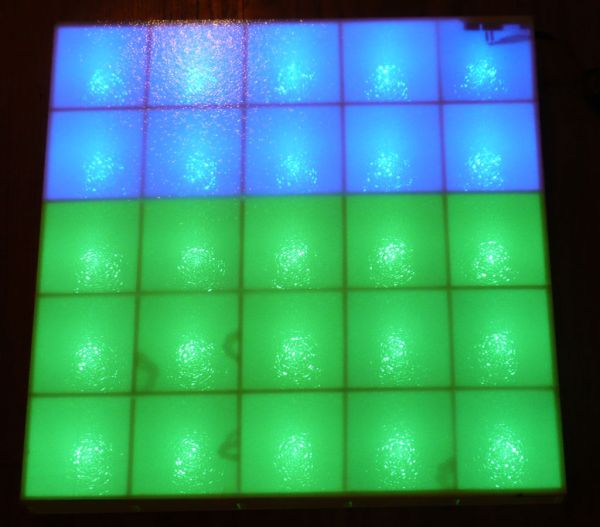
This project uses a couple of sheets of foam core, a fluorescent fixture cover from the local home store, a cut up strip of WS2812b LEDs, and an Arduino. All fairly inexpensive if you know where to get them (info below).
Major Components in Project
Parts:
- LEDs – this project uses 25 LEDs, and there are a few choices here. For this one, a strip of WS2812b LEDs was used. There were 30 per meter in the strip I ordered, which makes soldering easier since they are farther apart. The 60/meter strips would also work. The 144/meter would not work since they only have one set of solder pads between each LED to allow them to be so close, and for this project, we are soldering wires between them all and need soldering pads on both sides. You could also use the WS2801 based strands, and those are typically pre-wired, making the project even easier. The other Instructables cover those pretty well, so this one will not go into more detail on those. Use non-waterproof or silicone jacketed (the jacket can be slid or cut off) strips. Avoid the epoxy waterproofed ones since you will need to clean that off of each end of each LED – doable, but unnecessary work if you order the other kind.
- Foam Core – 2 sheets, 20″x30″, like these, though that link is 5x more than you need.
- Plastic cover – this is from the local home store and is used to cover fluorescent bulb fixtures. It’s called an acrylic lighting panel, and the style is cracked ice. There are other possibilities here – the main thing is there is enough frosting to diffuse the LED light. Since the lighting panels are about 24″x 48″, you can make two of these projects with one of them.
- Wire – each LED will have wires to connect to the next one – three wires between each. Hobby servo wire is nice to use since it’s already three wires and color coded nicely.
- An Arduino Uno will do. Clone Arduinos are are available for about $10 each – a key for the low cost goal of this project. There are also smaller versions of Arduinos that would also work well for this project in that same price range. Older Arduinos will work fine too.
- Recommended – a power jack to supply 5 volts to the system. You can use the Arduino power and regulator if most of the LEDs are not on at the same time, but if they will all be on, the external 5 volts supply will avoid overheating the Arduino regulator. This jac will match your power supply – for me, it was a 2.1mm ID, 5.5 mm OD panel mount jack.
Step 1: Making the Grid
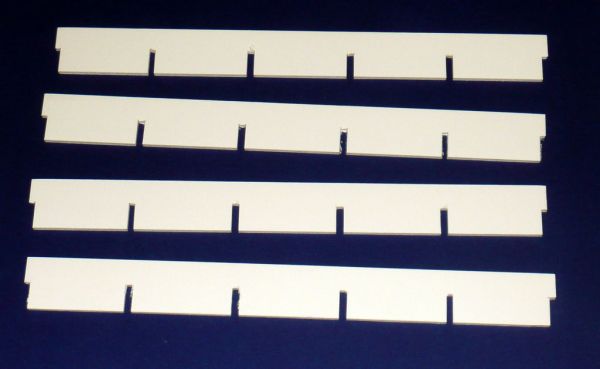
Cut (12) 2″ strips off the 20″ end of one piece of foam core. Cut the second piece of foam core into a 20″x20″ piece for the back.
On the strips, cut a 1/4″ wide, 1″ + 1/16″ deep slot on the end, and at 4″, 8″, 12″, and 16″ (see the pictures). They are all cut the same and will fit into each other. This is easy if you have a band saw, but you can use a hand saw or an X-Acto knife and some patience.
On 4 of them, cut a notch on the tops to run the wires. On 4 others, cut notches on the bottom left of two of them and the bottom right of the other two. The remaining 4 are the sides and need no notches (the pictures show each of the 4 types).
Don’t glue them all down yet since you will need to run the wires! I used hot melt glue. I glued the sides in first – added the strips in the one direction that is captured by the sides, but did not glue them yet. Then I noticed you can remove them by flexing them slightly, and removed them while gluing down the LEDs. Once all the LEDS are set, you can add glue as needed, but you may not actually need much more – depends how rigid you want it to be.
Cut the plastic lighting panel to 20″x20″. It is very brittle, so the special scoring tool they sell may help – otherwise a box cutter may work, but be sure to have the panel on a flat surface.
For more detail: Make A Low Cost LED Grid Using Arduino
- What type of LEDs does the project use?
The project uses WS2812b LEDs cut from a strip, totaling 25 LEDs. - Can I use waterproof epoxy-coated LED strips?
The article advises against epoxy waterproofed strips because you would need to clean off each end of each LED; non-waterproof or silicone-jacketed strips are recommended. - How is the frame for the grid made?
The frame is made from two foam core sheets: twelve 2" strips with slots and a 20"x20" back piece that slot together. - What is used to diffuse the LED light?
An acrylic lighting panel (fluorescent fixture cover, cracked ice style) is used to diffuse the LED light. - How are the LEDs wired together?
Three wires are run between each LED; hobby servo wire is recommended since it provides three conductors and color coding. - Do I need an external power supply?
An external 5 V supply with a matching power jack is recommended if many LEDs will be on to avoid overheating the Arduino regulator. - What cutting tools are suggested for the plastic panel?
The panel is brittle; a special scoring tool from the store or a box cutter on a flat surface is suggested. - How are notches and slots used in the foam strips?
Slots are cut to allow the strips to interlock; specific notches are cut on some strips to route wires and capture the grid structure. - Can I use different LED densities on the strip?
30 LEDs/meter or 60 LEDs/meter strips are suitable; 144/meter strips are not recommended due to lack of solder pads on both sides. - What adhesive is used to secure parts?
Hot melt glue is used to secure pieces, though the structure can be partially friction-fit before final gluing.
