
Summary of 4S Universal Preamplifier for 12A*7 Tubes
The 4S Universal Tube Preamplifier is a simple single-stage line stage designed to operate with various dual triode tubes, evolving from forum discussions on the "Super Simple Single Stage Preamp." It features a resistive load, grid stopper for clipping control, and an output volume potentiometer to minimize noise. The design ensures low distortion and flexible gain by adjusting tube selection and input resistor values (100kΩ–1MΩ).
Parts used in the 4S Universal Tube Preamplifier:
- Dual triode tubes
- Grid stopper resistor
- Pure resistive load
- High impedance grid resistor
- Volume control (P1)
- Input resistor
- Output potentiometer (250kΩ audio taper)
- Cathode bypass capacitor (optional 33µF)
The basis for this tube preamplifier started out as a post in the Super simple single stage tube preamp thread on the website Forum.
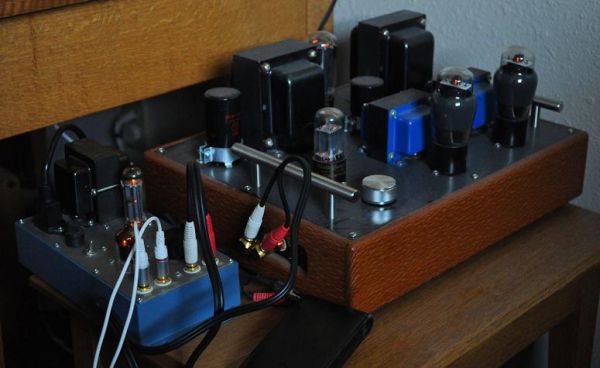
One of the members (see Mark’s 4S Universal Valve Preamps) had suggested building a Super Simple Single Stage Preamp (“4S” Preamp for short) and there was much discussion concerning various tubes, gain, noise, etc. and several designs were presented using various dual triode tubes. Then the proverbial gauntlet was thrown down with the phrase “switch from 12AU7 to 12AX7”. My answer was to design a universal line stage preamplifier that would work well with an entire range of tubes. Thus was the 4S Universal tube preamplifier born.
The tube preamplifier circuit is actually very simple. It uses a reasonably sized grid stopper to control clipping and bias excursions, a pure restive load, and a high impedance grid resistor to avoid loading virtually any driving device. The volume control (P1 on the schematic) is on the tube output to help ensure that the noise figure for this Hi-Fi preamp is as low as possible. The input resistor (470k on the schematic) can be anything from 100k to 1M to properly load your input source. With these components (the output potentiometer is 250kΩ audio taper) and an optional 33µF cathode bypass capacitor the calculated preamplifier performance is shown in the following table.
Where:
- ECo (V) – Cathode bias voltage in volts (Quiescet [zero excitation] value of grid voltage).
- Av – Amplification or gain (v/v or unitless).
- Av (dB) – Amplification or gain in decibels or dBv.
- %D (i/p 1vpp) – Percent distortion with a 1v peak (2v peak to peak) sine wave input.
- Ro (Ω max) – Maximum output impedance in ohms (ouptput impedance varies with potentiometer setting).
- flo (Hz) – Low frequency -3dB response frequency.
As can be seen from the calculated performance, the peak gain can be varied considerably by choice of tube and the distortion (virtually all second harmonic) is very well controlled. This is a well behaved line stage preamplifier.
For more detail: 4S Universal Preamplifier for 12A*7 Tubes
- What inspired the creation of the 4S Universal tube preamplifier?
The project was born after a member suggested building a Super Simple Single Stage Preamp and challenged others to switch from 12AU7 to 12AX7 tubes. - How does the circuit manage to keep the noise figure low?
The volume control is placed on the tube output to help ensure that the noise figure for this Hi-Fi preamp is as low as possible. - Can I use different values for the input resistor?
Yes, the input resistor can be anything from 100k to 1M to properly load your input source. - What type of volume control potentiometer is specified?
The output potentiometer is a 250kΩ audio taper. - Does adding a cathode bypass capacitor affect performance?
Yes, with an optional 33µF cathode bypass capacitor, the calculated preamplifier performance changes as shown in the provided table. - What kind of distortion does this preamplifier produce?
The distortion is virtually all second harmonic and is very well controlled. - How does the choice of tube impact the amplifier's gain?
The peak gain can be varied considerably by the choice of tube used in the circuit. - What component is used to control clipping and bias excursions?
A reasonably sized grid stopper is used to control clipping and bias excursions.
