
Summary of ELECTRIPOP TURNS CUT MYLAR INTO CUSTOM 3D STRUCTURES
ElectriPop is a Carnegie Mellon University project transforming flat Mylar sheets into dynamic 3D structures using electrostatic charge. By making precise cuts, the material lifts and forms shapes like flowers or avatars when charged. The team created a visualization tool to design cut patterns compatible with vector software, vinyl cutters, or lasers. A key component of the system is a miniature Arduino-controlled Van de Graaff generator that provides the necessary high voltage for these motion effects.
Parts used in the ElectriPop:
- Mylar sheet
- Electrostatic charge source
- Arduino microcontroller
- Van de Graaff generator
- High-voltage power supply
- Visualization software tool
- Vector art programs
- Vinyl cutter or laser cutter
Mylar has a lot of useful properties, and as such as see it pop up pretty often, not just in DIY projects but in our day-to-day lives. But until today, we’ve never seen a piece of Mylar jump up and try to get our attention. But that’s precisely the promise offered by ElectriPop, a fascinating project from Carnegie Mellon University’s Future Interfaces Group.
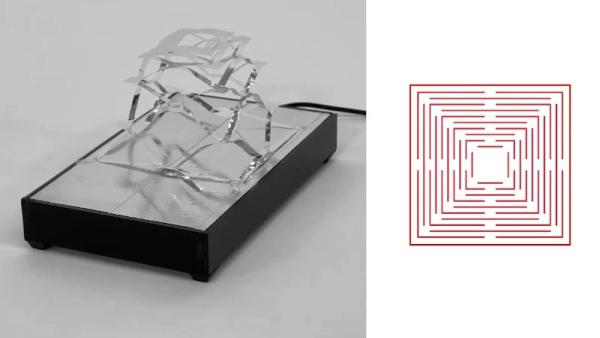
The core principle at work here is fairly simple. When electrostatically charged, a strip of Mylar can be made to lift up vertically into the air. Cut that strip down the center, and the two sides will repel each other and produce a “Y” shape. By expanding on that concept with enough carefully placed cuts, it’s possible to create surprisingly complex three dimensional shapes that pop up once a charge is applied. A certain degree of motion can even be introduced by adjusting the input power. The video after the break offers several examples of this principle in action: such as a 3D flower that either stands up tall or wilts in relation to an external source of data, or an avatar that flails its arms wildly to get the user’s attention.
As the relationship between the nested cuts, slits, and holes placed in the Mylar sheet and the final 3D shape isn’t particularly intuitive, the team has developed a visualization tool that can be used in conjunction with existing vector art programs to create a 2D cut file. Once you’re satisfied the design will inflate to the intended shape, it can quickly be implemented with a vinyl cutter or laser. The low barrier to entry makes this project particularly well suited for DIY replication, and we’re eager to see how the maker community could put this concept to work.
There are plenty of ways that you can charge up your new shape-changing Mylar display, but we particularly liked the team’s miniature Arduino-controlled Van de Graaff generator. It may represent the smallest and most simplistic implementation of this classic high-voltage generator that we’ve ever seen, and looks like a fun little project in itself.
ElectriPop was developed by [Cathy Mengying Fang], [Jianzhe Gu], and [Lining Yao] in collaboration with the director of the Future Interfaces Group, [Chris Harrison]. Readers may recall that in 2018 we covered VibroSight, another project from [Chris] and his students, which ultimately was scaled up to demonstrate laser non-contact sensing on city-scale just last year. Stay tuned for more from this innovative lab in the near future.
Source: ELECTRIPOP TURNS CUT MYLAR INTO CUSTOM 3D STRUCTURES
- How does ElectriPop make Mylar move?
When electrostatically charged, a strip of Mylar lifts vertically, and nested cuts allow it to form complex 3D shapes. - Can the shape change based on data?
Yes, adjusting input power allows for motion, such as a flower standing up or wilting based on external data sources. - What tool helps design the cut patterns?
The team developed a visualization tool that works with existing vector art programs to create 2D cut files. - How are the designs physically created?
Once designed, the cut files can be implemented using a vinyl cutter or a laser cutter. - What powers the shape-changing display?
The project uses a miniature Arduino-controlled Van de Graaff generator to provide the necessary charge. - Is this project suitable for DIYers?
Yes, the low barrier to entry makes it well suited for DIY replication by the maker community. - Who developed the ElectriPop project?
It was developed by Cathy Mengying Fang, Jianzhe Gu, Lining Yao, and Chris Harrison from Carnegie Mellon University. - Does the device require complex programming?
The article describes the implementation as simplistic and notes the low barrier to entry for users.
