
Summary of COIN ACCEPTORS ARE HIGHER-TECH THAN YOU THINK
This article details a teardown of a complex commercial coin acceptor that identifies coins by diameter, speed, and material using optical sensors and induction coils. The author reverse-engineered these principles to build an Arduino-based version. While the electronics and mechanics were analyzed, the homebrew project utilized a $20 commercial unit for the mechanical components to simplify construction.
Parts used in the Arduino Coin Acceptor Project:
- Arduino microcontroller
- Induction coils
- Photo electronics (optical sensors)
- Solenoid-driven flap
- Commercial coin acceptor unit ($20)
- Coin return slot
Coin-operated machines have a longer history than you might think. Ancient temples used them to dispense, for example, holy water to the faithful in return for their coins. Old payphones rang a bell when you inserted a coin so the operator knew you paid. Old pinball machines had a wire to catch things with holes in the middle so you couldn’t play with washers. But like everything else, coin acceptors have advanced quite a bit. [Electronoobs] shows a unit that can accept coins from different countries and it is surprisingly complex inside. He used what he learned from the teardown to build his own Arduino-based version.
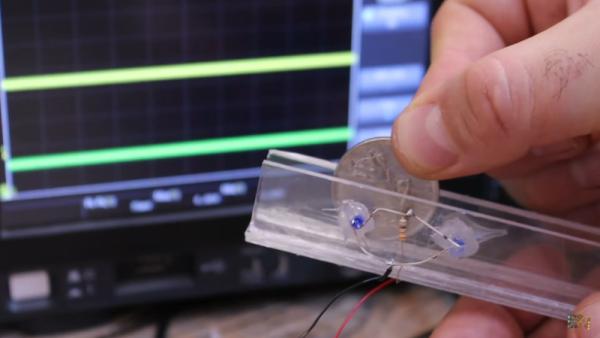
For scale, there is the obligatory banana. Inside the box there are several induction coils and some photo electronics. In particular, there are two optical sensors that watch the coin roll down a ramp. This produces two pulses. The width of the pulse indicates the diameter of the coin, and the time between the pulses tells its speed.
So what are the two coils for? They form a transformer, and the coin moving between the coils changes the coupling in a way that depends on the material. By knowing the diameter, the transit speed of the coin, and the material, you can identify the coin. A little solenoid-driven flap moves out of the way to store a recognized coin. If it doesn’t move out of the way, the coin goes out of the coin return slot.
We wondered how the machine knows about local currency and what happens if the composition of a coin changes. The video shows how you teach the device about a coin by inserting a sample coin multiple times and letting the device measure. So even if you had some custom token, it should work.
The homebrew solution is pretty easy, especially the optical part. The coils are a bit more work since you need a big coil along with the associated driver and sense electronics. Then, of course, there is also the mechanics, which he did not build, since the commercial product was only $20.
We always enjoy teardowns, but this one was especially informative, and we enjoyed the reproduction of the operating principles. Hero was a Greek who lived a long time ago and would have really been interested in this teardown. We couldn’t help but think, too, of [Peter’s] coin-operated calculator.
Source: COIN ACCEPTORS ARE HIGHER-TECH THAN YOU THINK
- How does the device identify a coin?
The machine identifies coins by measuring their diameter via pulse width, transit speed via time between pulses, and material composition via induction coil coupling. - What are the two optical sensors used for?
The two optical sensors watch the coin roll down a ramp to produce two pulses that determine the coin's size and speed. - Can the machine recognize custom tokens?
Yes, you can teach the device about any token by inserting a sample coin multiple times for it to measure. - How does the solenoid-driven flap work?
If a coin is recognized, the flap moves out of the way to store it; otherwise, the coin exits through the return slot. - Why did the builder use a commercial unit for mechanics?
The builder did not build the mechanics because the commercial product was only twenty dollars. - What historical precedent do coin-operated machines have?
Ancient temples used them to dispense holy water, and old pinball machines had wires to prevent playing with washers. - Does the coin acceptor handle different currencies?
Yes, the commercial unit shown accepts coins from different countries. - What happens if coin composition changes?
The device learns new compositions by having the user insert a sample coin multiple times to update its measurements.
