
Summary of MICROCHIP MCP2518FD : EXTERNAL CAN FD CONTROLLER WITH SPI INTERFACE
The MCP2518FD is a compact, low-cost external CAN FD controller that connects to a microcontroller via SPI to add CAN or CAN FD channels. It supports Classical CAN 2.0B and CAN FD per ISO11898-1:2015, offers up to 1 Mbps arbitration and 8 Mbps data rates, a 20 MHz SPI clock, flexible FIFO configuration, diagnostics, low power modes, and built-in safety features including CRC-protected SPI commands and ECC-protected SRAM.
Parts used in the MCP2518FD Project:
- MCP2518FD External CAN FD Controller
- Microcontroller with SPI interface
- SPI bus (connections such as MOSI, MISO, SCK, CS)
- Power supply (VDD 2.7V to 5.5V)
- CAN transceiver (to interface controller to CAN bus)
- Decoupling capacitors and basic PCB components
- Optional SOIC14 or VDFN14 (package choice)
The MCP2518FD is a cost-effective and small-footprint External CAN FD Controller that can be easily added to a microcontroller with an available SPI interface.
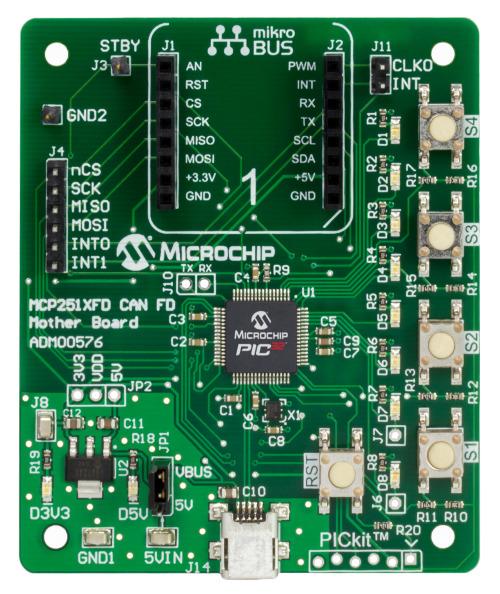
Therefore, a CAN FD channel can be easily added to a microcontroller that is either lacking a CAN FD peripheral or that doesn’t have enough CAN FD channels.
The MCP2518FD supports both CAN frames in the Classical format (CAN 2.0B) and CAN Flexible Data Rate (CAN FD) format as specified in ISO11898-1:2015.
- Conforms to ISO11898-1:2015
- Supports both CAN 2.0B and CAN FD
- Arbitration Bit Rate up to 1 Mbps
- Data Bit Rate up to 8 Mbps
- Up to 20MHz SPI Clock Speed
- Flexible FIFO Setup
- 31 FIFOs configurable as transmit or receive
- 32 Transmit Queue
- Misc
- 32-bit Time Stamp
- Bus Health Diagnostics and Error Counters
- Temperature Range: -40°C to +150°C
- Packages: VDFN14 (Wettable Flanks), SOIC14
- Low Power Consumption
- Low power mode current: 10μA, Max
- VDD: 2.7V-5.5V
- Active Current Max: 12mA @ 5.5V, 40 MHz CAN Clock
- Built-In Safety Features
- Loopback mode
- SPI commands with CRC to detect noise on SPI interface
- ECC for the SRAM 1 bit correction, 2 bit detection
Read more: MICROCHIP MCP2518FD : EXTERNAL CAN FD CONTROLLER WITH SPI INTERFACE
- Can the MCP2518FD add CAN FD to a microcontroller that lacks CAN FD?
Yes, it is an external CAN FD controller that can be added via SPI to provide CAN FD functionality. - Does the MCP2518FD support Classical CAN as well as CAN FD?
Yes, it supports both CAN 2.0B (Classical) and CAN FD per ISO11898-1:2015. - What arbitration and data bit rates does the MCP2518FD support?
It supports arbitration bit rates up to 1 Mbps and data bit rates up to 8 Mbps. - What SPI clock speed does the MCP2518FD support?
It supports SPI clock speeds up to 20 MHz. - How many FIFOs does the MCP2518FD provide and are they configurable?
It provides 31 FIFOs that are configurable as transmit or receive. - Does the MCP2518FD include safety and diagnostic features?
Yes, it includes bus health diagnostics, error counters, CRC-protected SPI commands, and ECC for SRAM. - What are the operating voltage and temperature ranges for the MCP2518FD?
Operating VDD is 2.7V to 5.5V and temperature range is -40°C to +150°C. - What are the package options for the MCP2518FD?
Package options include VDFN14 (with wettable flanks) and SOIC14. - What is the low power consumption of the MCP2518FD?
Low power mode current is 10 μA maximum; active current is up to 12 mA at 5.5V with a 40 MHz CAN clock.
