
Summary of In 8-channel clock IC siLabs uses on-chip crystal
Silicon Labs introduces the Si5350/51, a family of in-circuit programmable CMOS clock generators featuring on-chip voltage-controlled crystal oscillators. These devices utilize patented technologies to synthesize up to eight distinct output frequencies without external PLLs, achieving 0 ppm error at speeds up to 133MHz. They support glitchless frequency shifting for audio and video applications and simplify system design by integrating timing domains into a single chip.
Parts used in the Si5350/51 Clock Generator Project:
- Silicon Labs Si5350/51 device
- In-circuit programmable CMOS clock generator
- On-chip voltage-controlled crystal oscillator
- CME MS technology
- DSPLL technology
- MultiSynth technology
- Crystal input
- Reference clock input
- Analogue control voltage input
Silicon Labs offers the industry’s broadest portfolio of clocks, buffers and oscillators for communications, computing, consumer, data center, wireless infrastructure and broadcast video applications. Leveraging patented CMEMS®, DSPLL® and MultiSynth technologies, these timing ICs eliminate the need for many expensive discrete components while improving performance, minimizing board space and simplifying system designs.
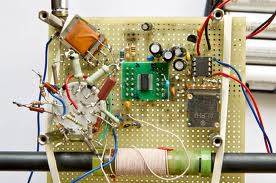
Silicon Laboratories has a range of in-circuit programmable CMOS clock generators with on-chip voltage-controlled crystal oscillators.
Unlike traditional clock generators that require a separate PLL to synthesize each non-integer related output frequency, the Si5350/51 devices will synthesise a different frequency on each of their eight output clocks.
The Si5350/51 generates system clocks up to 133MHz with 0 ppm frequency error.
The Si5350/51 can also simultaneously generate free-running clocks from a crystal input as well as clocks synchronized to a reference clock or analogue control voltage input, allowing multiple board-level timing domains to be clocked from a single device.
The aim, said the supplier, is to provide glitchless frequency shifting between two rates on up to six of the device outputs.
“This frequency shifting technique simplifies clock synthesis in audio and video applications, which often require a combination of frequencies to support multiple formats and display standards,” said the company.
It can also ease the problem of processor overclocking.
Silicon Laboratories has a range of in-circuit programmable CMOS clock generators with on-chip voltage-controlled crystal oscillators.
Unlike traditional clock generators that require a separate PLL to synthesize each non-integer related output frequency, the Si5350/51 devices will synthesise a different frequency on each of their eight output clocks.
The Si5350/51 generates system clocks up to 133MHz with 0 ppm frequency error.
The Si5350/51 can also simultaneously generate free-running clocks from a crystal input as well as clocks synchronized to a reference clock or analogue control voltage input, allowing multiple board-level timing domains to be clocked from a single device.
The aim, said the supplier, is to provide glitchless frequency shifting between two rates on up to six of the device outputs.
“This frequency shifting technique simplifies clock synthesis in audio and video applications, which often require a combination of frequencies to support multiple formats and display standards,” said the company.
It can also ease the problem of processor overclocking.
For more detail: In 8-channel clock IC siLabs uses on-chip crystal
- What technology does Silicon Labs use to eliminate discrete components?
The company uses patented CMEMS, DSPLL, and MultiSynth technologies. - How many output clocks can the Si5350/51 generate simultaneously?
The device synthesizes a different frequency on each of its eight output clocks. - Does the Si5350/51 require a separate PLL for non-integer related output frequencies?
No, unlike traditional generators, it synthesizes these frequencies internally without a separate PLL. - What is the maximum system clock speed supported by the Si5350/51?
The device generates system clocks up to 133MHz with 0 ppm frequency error. - Can the Si5350/51 perform glitchless frequency shifting?
Yes, it provides glitchless frequency shifting between two rates on up to six outputs. - What types of inputs allow multiple board-level timing domains to be clocked from one device?
It supports crystal inputs, reference clocks, and analogue control voltage inputs. - How does this frequency shifting technique benefit audio and video applications?
It simplifies clock synthesis by supporting multiple formats and display standards requiring combined frequencies. - Does the Si5350/51 help with processor overclocking issues?
Yes, the device can ease the problem of processor overclocking.
