
Summary of LADYBUG: THE HIGH-QUALITY MOTORIZED MICROSCOPE AND 3D SCANNER
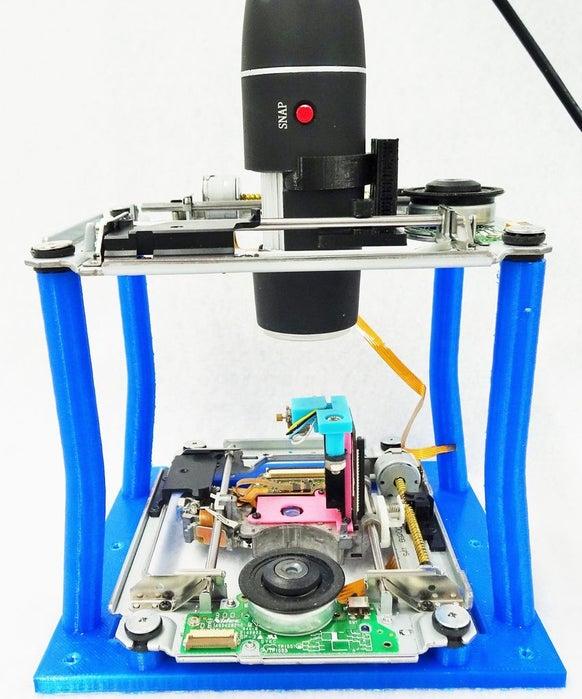
Ladybug is a compact, low-cost 4-axis motorized microscope and picture-based 3D scanner built largely from Blu-Ray player parts and 3D-printed components. It uses a USB microscope and Raspberry Pi to capture extremely small details (under 10 microns) by combining 2D and 3D motorized scanning, enabling high-resolution images of tiny objects without time-consuming manual stitching.
Parts used in the Ladybug:
- Blu-Ray player parts (motors and mechanical assemblies)
- 3D printed parts (structural components and mounts)
- USB microscope (high-powered, low-cost)
- Raspberry Pi (controls camera and capture)
- 4-axis stepper or DC motors (for motorized movement)
- Motor controllers or drivers (to drive the motors)
- Wiring and connectors (power and data connections)
- Mounting hardware (screws, brackets)
- Platform or stage for the object
Imagine that you wanted to take a picture of a very small object and you still need to zoom in as much as possible to get the smallest detail of the picture. If you have been at this stop before, then you obviously did not try taking the whole picture at once.
You must have tried using a number of motors to move the object or the camera while you take a couple of pictures and then join the parts together or probably even tried doing 2D scanning a lot of times where each time you pause to take a picture, you take as many as you need to cover the object at the right resolution. All these options are good, but are not the best options that can be — they are time-consuming and can introduce subtle distortions in your image.
“Ladybug is a picture-based 3D scanner, meaning that it’s primary function is to take photographs of an object from all sides, which can then be turned into a 3D model. What’s special about it is what it takes the picture with, how it takes the pictures, and what it’s made of. First, it uses a high-powered USB microscope, which is both cheap and effective — as long as you’re just looking at a tiny part of the object! LadyBug solves this by using motors to do 3D scanning on top of 2D scanning”, writes Noselace about the miniature microscope and 3D scanner.
Made almost entirely out of Blu-Ray players and 3D printed parts, the Ladybug is a 4-axis motorized microscope and a 3D scanner for extremely small objects. The camera system is made up of a low-cost USB microscope powered by a Raspberry Pi that makes it easy to capture details less than 10 microns. The LadyBug can also be set up to perform 2D scanning as long as it fits into the platform you are working with.
Read more: LADYBUG: THE HIGH-QUALITY MOTORIZED MICROSCOPE AND 3D SCANNER
- What is Ladybug?
Ladybug is a 4-axis motorized microscope and picture-based 3D scanner for extremely small objects. - What components make up Ladybug?
Ladybug is made almost entirely from Blu-Ray player parts, 3D printed parts, a USB microscope, and a Raspberry Pi, plus motors and controllers. - What kind of camera does Ladybug use?
Ladybug uses a low-cost high-powered USB microscope as its camera system. - What level of detail can Ladybug capture?
Ladybug can capture details less than 10 microns. - Can Ladybug perform 2D scanning?
Yes, Ladybug can be set up to perform 2D scanning if the object fits on its platform. - How does Ladybug achieve 3D scanning?
Ladybug uses motors to perform 3D scanning on top of 2D scanning, taking photographs from multiple sides to create a 3D model. - What role does the Raspberry Pi play in Ladybug?
The Raspberry Pi powers the USB microscope and facilitates easy capture of images. - Why use Blu-Ray player parts?
Blu-Ray player parts provide low-cost motors and mechanical assemblies used to build the motion system.
