
Summary of USING A VENDING MACHINE BILL ACCEPTOR WITH ARDUINO
This article describes a teardown and Arduino interfacing of a vending-machine bill acceptor, showing how belts, IR LEDs, and sensors scan bills to distinguish real currency from paper, and noting firmware updates are required for new bill designs; the creator’s unit is outdated and cannot read current $5 bills. It links to a video and references past DIY uses like a Bitcoin ATM.
Parts used in the Bill Acceptor Project:
- Bill acceptor unit (vending-machine style)
- Belts for bill transport
- Infrared LEDs for scanning
- Optical sensors/detectors
- Control electronics/PCB inside the acceptor
- Firmware on the bill acceptor
- Arduino microcontroller
- Wiring/connectors to interface Arduino and acceptor
- Power supply for the acceptor and Arduino
We have all encountered bill acceptors like the one [Another Maker] recently removed from an arcade machine and sometimes struggled with them. Have you ever disassembled one to observe its functioning? If not, the video following this is an intriguing look at how this common device distinguishes between a genuine bill and a sheet of paper.
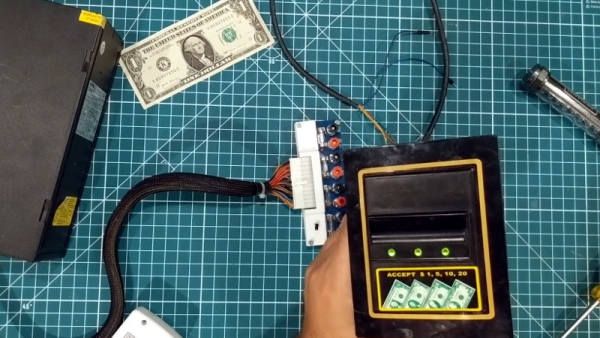
But [Another Maker] goes a bit farther than just showing the internals of the device. He also went through the trouble of figuring out how to talk to it with an Arduino, which makes all sorts of money-grabbing projects possible. Even if collecting paper money isn’t your kind of thing, it’s still interesting to see how this gadget works on a hardware and software level.
As mentioned in the video, a collection of belts is utilized to move the bill in front of multiple IR LEDs. The hardware relies on these tools to scan the bill and use some sort of mysterious sorcery to verify if it’s a real piece of currency. [Another Maker] emphasizes that these readers must be updated with firmware periodically to accommodate new bill designs. Indeed, the unit he owns is extremely outdated to the point that it cannot process current $5 bills, possibly clarifying why he received it for no cost initially.
Years ago we saw one of these bill acceptors used to make a DIY Bitcoin ATM. Of course back then, a few bucks would get you a semi-reasonable amount of BTC. These days you would skip the paper currency and do it all digitally.
Source: USING A VENDING MACHINE BILL ACCEPTOR WITH ARDUINO
- Can a bill acceptor distinguish real bills from paper?
Yes; the device scans bills using belts to move them past IR LEDs and sensors to verify authenticity. - Does the bill acceptor require firmware updates?
Yes; the article says readers must be updated with firmware periodically to accommodate new bill designs. - Can an Arduino communicate with a bill acceptor?
Yes; the creator figured out how to talk to the unit with an Arduino. - Why might a bill acceptor fail to read current bills?
Because its firmware can be outdated and not recognize newer bill designs, as with the unit that cannot process current $5 bills. - What components move the bill inside the acceptor?
A collection of belts is utilized to move the bill in front of multiple IR LEDs. - Is disassembling a bill acceptor useful for understanding its operation?
Yes; disassembly reveals the hardware and sensor arrangement and helps in learning how it distinguishes bills from paper. - Was the bill acceptor used in any DIY projects before?
Yes; the article references a past use of a similar acceptor to build a DIY Bitcoin ATM. - Is collecting paper money necessary for using such a device with Arduino?
No; even if collecting paper money is not desired, the hardware and software aspects remain interesting for study.
