
Summary of Laser Beam Wireless Smartphone Chargers: The Next Big Thing
The University of Washington researchers developed a laser-based system capable of remotely charging smartphones at speeds comparable to USB cables. This technology delivers power over distances up to 14 feet or potentially 40 feet with beam expansion. Crucially, the design incorporates safety mechanisms including a metal heat sink to manage thermal output and a reflector-based system that instantly terminates the laser beam if an obstruction is detected, ensuring safe operation in commercial and home environments.
Parts used in the Laser Beam Wireless Smartphone Charger:
- Laser emitter
- Smartphone with embedded metal flat-plate heat sink
- Reflector based system for obstruction detection
- Charging beam targeting mechanism
Cellphone chargers have been in existence for years and have grown from one stage to another. It started with the mobile phone traditional charger which had a USB interface, a DC converter, and a charging plug and now has expanded to a close-range inductive wireless charging. The commonly used inductive wireless charging is nice but limited, it still requires close contact with the charging pad making it offer little or no advantage to cable-based chargers. We have seen some potential long-range wireless chargers especially those from the PowerSpot, which in theory could charge up to 80 feet away. Among those technologies, charging with a laser beam is a possibility the research team from the University of Washington is evaluating.
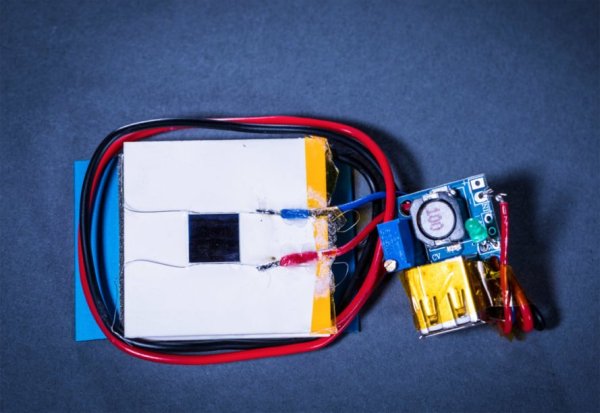
Researchers from the UW’s (University of Washington), Paul G. Allen School of Computer Science & Engineering, have designed a laser system that can remotely charge your smartphones as quickly as a standard USB cable. They have embedded essential safety features which include a metal, flat-plate heat sink on the smartphone to dissipate excess heat from the laser, as well as a reflector based system to turn off the laser if a person tries to get in the way of the charging beam.
Shyam Gollakota, an associate professor at the UW’s Paul G. Allen School of Computer Science & Engineering said “We have designed, constructed and tested this laser-based charging system with a rapid-response safety mechanism, which ensures that the laser emitter will terminate the charging beam before a person comes into the path of the laser”.
“In addition to the safety mechanism that quickly terminates the charging beam, our platform includes a heatsink to dissipate excess heat generated by the charging beam,” said Arka Majumdar, a UW assistant professor of physics and electrical engineering. “These features give our wireless charging system the robust safety standards needed to apply it to a variety of commercial and home settings,” he said.
A narrow beam can deliver a steady 2 Watts of power to 15 square-inch area from a distance of up to 4.3 meters, or approximately 14 feet. But the emitter can be redesigned to expand the charging beam’s radius to an area of up to 100 square centimeters from a distance of 12 meters, which is close to 40 feet. This extension means that the emitter could be targetted at a broader charging surface area, such as a tabletop or a desk, and efficiently charge a smartphone placed anywhere on that surface.
Read more: Laser Beam Wireless Smartphone Chargers: The Next Big Thing
- How fast can the laser system charge a smartphone?
The system charges smartphones as quickly as a standard USB cable. - What safety features are included in the design?
It includes a metal flat-plate heat sink and a reflector based system to turn off the laser if someone blocks the beam. - Can the laser beam be expanded to cover a larger area?
Yes, the emitter can be redesigned to expand the radius to 100 square centimeters from a distance of 12 meters. - Does the system terminate the laser beam automatically?
Yes, the rapid-response safety mechanism ensures the laser emitter terminates the beam before a person enters the path. - What is the maximum distance for the narrow beam configuration?
The narrow beam delivers power from a distance of up to 4.3 meters or approximately 14 feet. - Is this technology suitable for home settings?
Yes, the platform includes robust safety standards needed to apply it to various commercial and home settings. - How much power does the narrow beam deliver?
A narrow beam can deliver a steady 2 Watts of power to a 15 square-inch area. - Who developed this laser charging system?
Researchers from the University of Washington Paul G. Allen School of Computer Science & Engineering designed the system.
