
Summary of Arduino Line Tracking Robot Car
This article details a line tracking robot car built upon a previous prototype, featuring design improvements for enhanced efficiency and performance. Key upgrades include replacing BJT transistors with MOSFETs, using geared motors for better torque and stability, and adding a front ball bearing to increase speed. The project utilizes a custom-fabricated PCB to ensure a compact, lightweight, and tidy chassis integration.
Parts used in the Line Tracking Robot Car:
- PCB
- Geared Motor
- OSRAM Opto Semiconductors Photodiode
- Nichia LED
- RS 10k Ohm resistor
- RS 470 Ohm resistor
- RS 100 ohm Resistor
- STMicroelectronics STP36NF06L N-channel MOSFET Transistor
- Fairchild Semiconductor 1N4004 Diode
- Nichion 47uF Capacitor
This line tracking robot car was built base on the prototype mentioned in the previous knowledge item.
You can find the details for the prototype:
Bills of Materials:
PCB
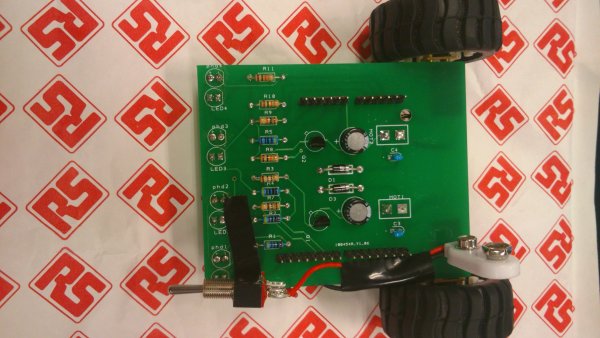
Geared Motor
OSRAM Opto Semiconductors Photodiode (RS stock number: 654-8902)
Nichia LED (RS stock number: 713-3996)
RS 10k Ohm resistor (RS stock number: 707-8906)
RS 470 Ohm resistor (RS stock number: 707-8851)
RS 100 ohm Resistor (RS stock number: 707-8142)
Fairchild Semiconductor PN2222ATA Transistor(RS stock number: 739-0381)
Fairchild Semiconductor 1N4004 Diode(RS stock number: 759-6678)
Nichion 47uF Capacitor(RS Stock Number:475-9425)
Muraia 0.1uF Capacitor(RS Stock Number:653-0119)
Arduino Leonardo (RS stock number: 713-3996)
Since the geared motor is easier to control the speed and creates a larger torque compare with the ordinary DC motor, geared motors is used rather than using motors in this robot car. After using the geared motor, the torque is larger and the stability of the performance increases.
Also, a PCB was fabricated based on the schematic mentioned previously. Therefore, the car chassis is tidier and easier to integrate. It is lighter as well.
In order to have a higher efficiency, the transistors were changed from BJT to MOSFET. Also, we have added a ball bearing at the front of the car, the speed of the car becomes faster obviously.
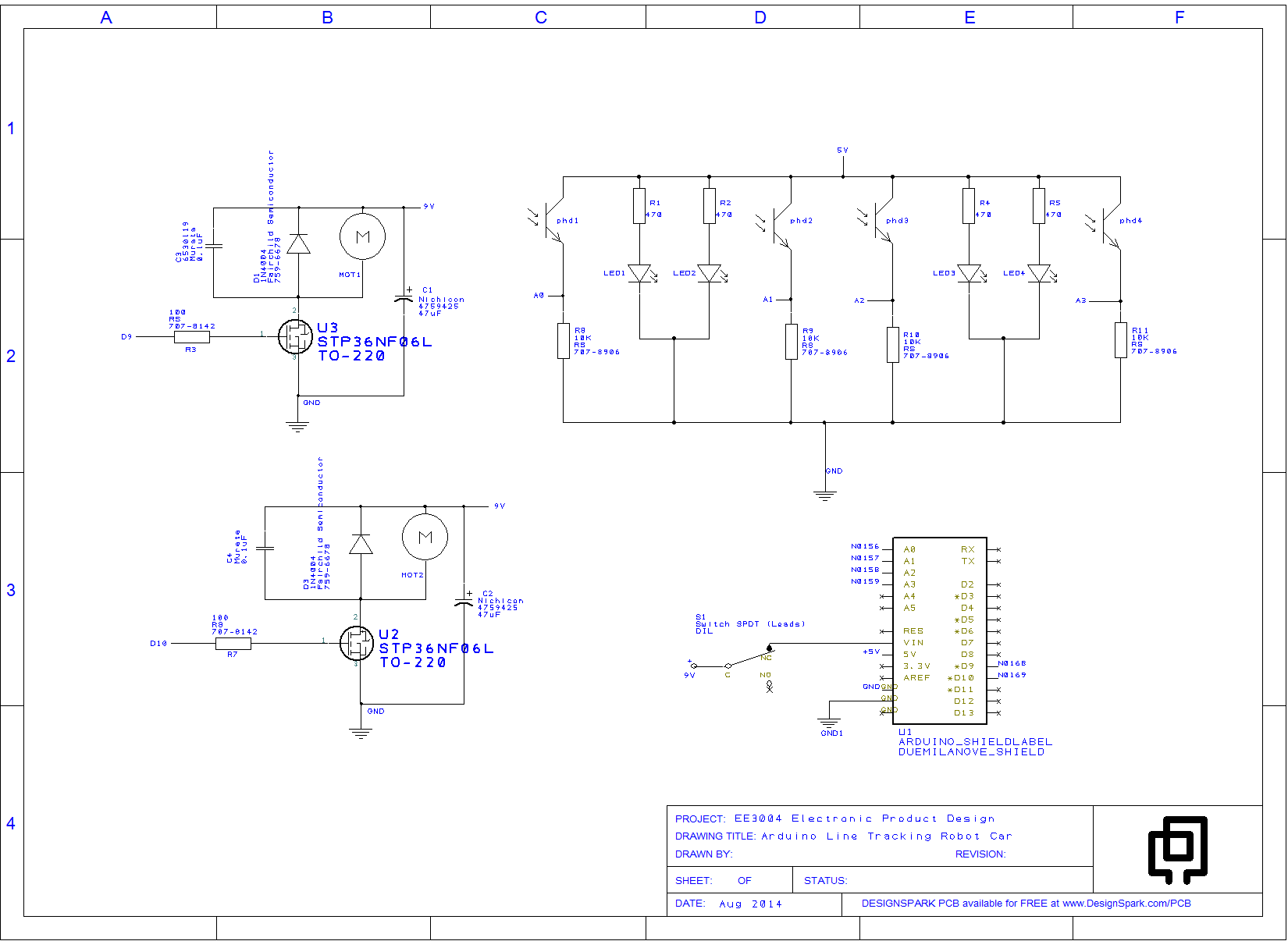
PCB
Geared Motor
OSRAM Opto Semiconductors Photodiode (RS stock number: 654-8902)
Nichia LED (RS stock number: 713-3996)
RS 10k Ohm resistor (RS stock number: 707-8906)
RS 470 Ohm resistor (RS stock number: 707-8851)
RS 100 ohm Resistor (RS stock number: 707-8142)
STMicroelectronics STP36NF06L, N-channel MOSFET Transistor(RS stock number: 486-5671)
Fairchild Semiconductor 1N4004 Diode(RS stock number: 759-6678)
Nichion 47uF Capacitor(RS Stock Number:475-9425)
Read More: Arduino Line Tracking Robot Car
- Why were geared motors used instead of ordinary DC motors?
Geared motors are easier to control speed and create larger torque compared to ordinary DC motors, which increases the stability of the performance. - How did changing transistors affect the robot's efficiency?
Transistors were changed from BJT to MOSFET to achieve higher efficiency. - What component was added to make the car faster?
A ball bearing was added at the front of the car, making the speed of the car faster obviously. - What is the benefit of fabricating a PCB for this project?
The fabricated PCB makes the car chassis tidier, easier to integrate, and lighter. - Does the article mention specific stock numbers for components?
Yes, the article lists RS stock numbers for parts like the Photodiode, LED, resistors, diode, capacitor, and MOSFET. - Can I find the details for the original prototype online?
Yes, details for the prototype are available at the provided link on rs-online.com/designspark.
