
Summary of LSF0204 breakout board: a bidirectional, multi-voltage level converter!
Summary: A compact 1.6 x 1.6 cm breakout board for TI’s LSF0204(D) bidirectional multi-voltage level translator was designed to reliably connect devices like ESP8266 to Arduinos. It supports translations between 1.0–3.3 V and up to 5 V, includes decoupling capacitors, optional I2C pull-ups, jumper/solder selection for LSF0204 vs LSF0204D, and an EN pull resistor. Boards were fabricated (DirtyPCBs) and are easy to assemble by hand.
Parts used in the LSF0204 breakout board:
- U1: LSF0204 or LSF0204D IC, TSSOP-14 package
- C1: 0.1uF decoupling capacitor, 0805 package
- C2: 0.1uF decoupling capacitor, 0805 package
- R1: 4.7k–10k ohm resistor, 0805 package (optional I2C pull-up)
- R2: 4.7k–10k ohm resistor, 0805 package (optional I2C pull-up)
- R3: 4.7k–10k ohm resistor, 0805 package (optional I2C pull-up)
- R4: 4.7k–10k ohm resistor, 0805 package (optional I2C pull-up)
- R5: 4.7k–10k ohm resistor, 0805 package (optional I2C pull-up)
- R6: 4.7k–10k ohm resistor, 0805 package (optional I2C pull-up)
- R7: 4.7k–10k ohm resistor, 0805 package (optional I2C pull-up)
- R8: 4.7k–10k ohm resistor, 0805 package (optional I2C pull-up)
- R9: 10k ohm resistor, 0805 package (pull-down for EN when using LSF0204D)
- SJ1: solder jumper to VA for selecting LSF0204 (non-D) EN behavior
I needed a small, fast and reliable multi-voltage level translator (mainly for connecting ESP8266 boards to the Arduino, got tired of resistor networks pretty quickly) so I built a breakout board for TI’s LSF0204(D).
Datasheet and info here.
The LSF0204 is a nice little chip. It can translate up to 4 signals to and from the following values:
1.0 V ↔ 1.8/2.5/3.3/5 V.
1.2 V ↔ 1.8/2.5/3.3/5 V.
1.8 V ↔ 2.5/3.3/5 V.
2.5 V ↔ 3.3/5 V.
3.3 V ↔ 5 V.
It’s very easy to use: connect the reference voltages to VA (1.0-4.5V) and VB (1.8-5.5V), and your signals to A1/2/3/4 or B1/2/3/4. It will translate and output them to the opposite A or B pins.
Features and parts list
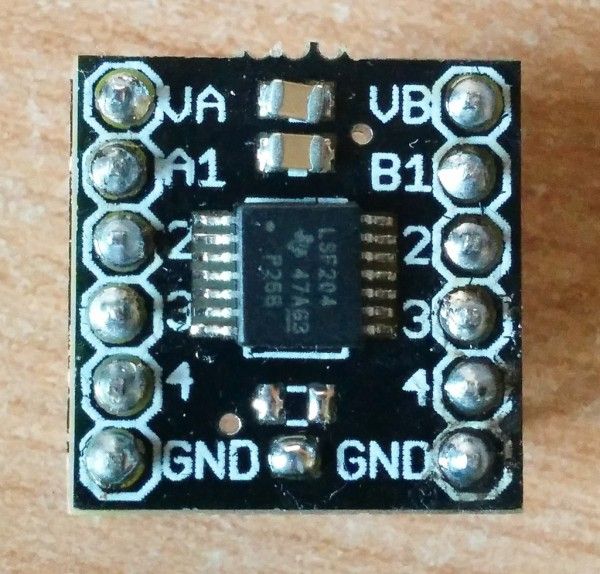
- Compatible with both LSF0204 (short jumper) and LSF0204D (solder/short the resistor between the “4” pins).
- Decoupling caps on both voltage lines.
- Optional I2C pull-up resistors (on the back of the board) connected to VA and VB.
- As small as possible! Just 1.6 x 1.6cm!
Parts list:
- U1: LSF0204(D) IC, TSSOP-14 package.
- C1,C2: 0.1uF 0805 package.
- R1-R8: 4.7k-10k ohm, 0805 package (I2C pull-ups, optional).
- R9: 10k ohm, 0805 package. Pull-down resistor to GND, for LSF0204D: the EN pin is active low.
- SJ1: solder jumper to VA, connect for LSF0204 (non-D): the EN pin is active high.
Pictures!
And here’s a couple of picture of some of the boards I received, printed by DirtyPCBs. Awesome service! Also, the black soldermask rocks.
It was also my first try at panelizing and I can say it worked pretty well!
Here a fully assembled one. The chip is pretty small but it was easy to solder with the help of a liquid flux pen and my new Yihua-858D hot air station. Don’t worry, you can solder it with a regular iron too!
For more detail: LSF0204 breakout board: a bidirectional, multi-voltage level converter!
- What voltage ranges can the LSF0204 translate between?
It can translate 1.0 V or 1.2 V to 1.8/2.5/3.3/5 V; 1.8 V to 2.5/3.3/5 V; 2.5 V to 3.3/5 V; and 3.3 V to 5 V. - How many signals can the breakout board translate?
The LSF0204 translates up to four signals bidirectionally. - How do you select between LSF0204 and LSF0204D on the board?
Use the solder jumper or short the resistor between the 4 pins: short jumper for LSF0204, or solder/short the resistor for LSF0204D. - Does the board include decoupling capacitors?
Yes, there are decoupling capacitors on both voltage lines (C1 and C2, 0.1uF 0805). - Are I2C pull-up resistors included?
Optional I2C pull-up resistors are provided on the back of the board and are connected to VA and VB. - What is the purpose of R9 on the board?
R9 is a 10k ohm pull-down resistor to GND for the LSF0204D because its EN pin is active low. - How large is the breakout board?
The board dimensions are 1.6 x 1.6 cm. - Can the LSF0204 be soldered by hand?
Yes, the designer reports it was easy to solder by hand using liquid flux and hot air, and it can also be soldered with a regular iron.
