
Summary of Tiny NFC reader with a TRF7970A
This article describes a low-power NFC tag reader platform based on the ATMega32U4 microcontroller and TRF7970A transceiver. The project supports standalone operation or PC peripheral use, featuring wireless data transmission via NRF24L01 and battery management through a bq24232h charger. Although originally intended for libnfc support, the author paused development due to IC issues but shares the PCB design for future upgrades.
Parts used in the Tiny NFC reader with a TRF7970A:
- USB-enabled ATMega32U4
- NRF24L01 connector
- Lithium-Ion battery charger (bq24232h)
- NFC transceiver (TRF7970A)
- Proximity sensor
- Expansion header
- Standard coil
Want a free board? Read below!
My regular readers may already know that I never stop working on a project half-way. This is unfortunately the only exception so far, motivated by the fact that an IC isn’t doing what it’s supposed to do, that my thread on the TI support forum was left unanswered for months and that I’d like to upgrade some of the chosen hardware.
So a few months ago I wrote a quick post about using a standard coil for NFC tag implant reading. The PCB you saw in the article is the one I’ll be writing about.
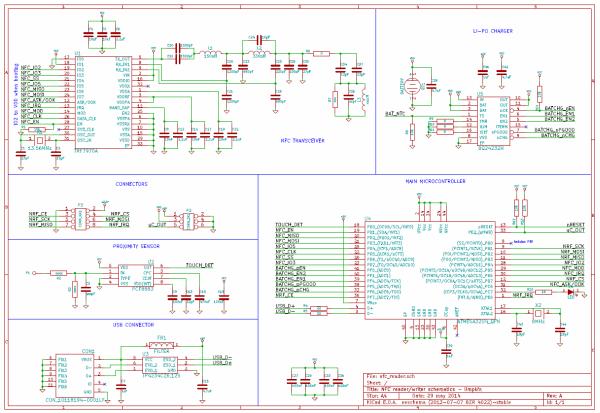
The Schematics
The main components are:
– the USB-enabled ATMega32U4
– a connector for the NRF24L01
– a Lithium-Ion battery charger
– an NFC transceiver
– a proximity sensor
The main idea of this platform is to read NFC tags while keeping its power consumption low. The microcontroller is communicating with the NFC transceiver so you can use the platform as a standalone device or computer peripheral.
You could therefore control a switch (using the expansion header), send the tag data via RF (using a NRF24L01 you’d connect) or simply have the ATMega32U4 forward the read/write commands sent from your computer. The original idea was to support libnfc.
The Li-Ion battery charger
The bq24232h is a neat little chip that is very convenient when having a USB powered platform. It’ll of course charge your battery but will also behave like a standard LDO when none is connected. As Li-on battery charges can be very complex it has several inputs used to set the optimal charging parameters (charging/termination current, pre-charge/fast-charge safety timers, maximum current on the 5V USB input…). If you look at its datasheet you’ll see on page 17/18 how a proper li-ion charge should be done. The chip can also monitor the battery temperature and even has short-circuit protection.
For more detail: Tiny NFC reader with a TRF7970A
- What is the main purpose of this platform?
The main idea is to read NFC tags while keeping power consumption low. - How can the microcontroller communicate with other devices?
The microcontroller communicates with the NFC transceiver to allow standalone use or as a computer peripheral. - Can I control a switch using this device?
Yes, you can control a switch using the expansion header. - How does the device send tag data wirelessly?
You can send the tag data via RF by connecting an NRF24L01 module. - What function does the bq24232h chip serve?
The bq24232h charges the Li-Ion battery and behaves like a standard LDO when no battery is connected. - Does the charger monitor battery conditions?
Yes, the chip can monitor battery temperature and has short-circuit protection. - What was the original software goal for this hardware?
The original idea was to support libnfc. - Why did the author pause work on this project?
Work was paused because an IC was not functioning correctly and TI support forum threads went unanswered.
