
Summary of Arduino Spectrometer-on-a-Chip
NanoLambda's Apollo is a $10 spectrometer chip using nano fusion technology to measure light wavelengths with 1 nm accuracy. This compact sensor reduces costs and size by 99% compared to traditional equipment, enabling wearable health monitoring and infrared detection.
Parts used in the Apollo Spectrometer:
- Apollo spectrometer sensor chip
- Nanofilter arrays
A California-based start-up called NanoLambda have developed a low-cost ($10) spectrometer sensor chip called Apollo which makes possible a wide range of new sensing applications. The sensor is capable of measuring individual wavelengths of light and is accurate to 1 nm with 10 nm resolution.
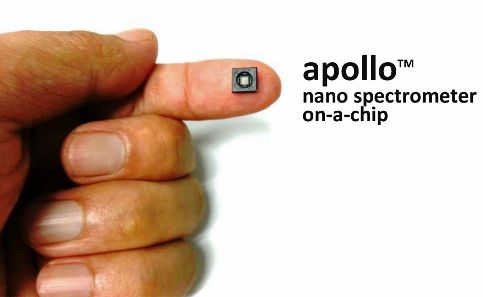
Optical spectroscopy is a very powerful non-invasive diagnostic technique and has been used for decades in many fields including health care. However the equipment cost using traditional methods of spectrum analysis has limited its area of application to professional use only. Using the company’s nano fusion technology NanoLambda have fabricated a sensor from thin nanofilter arrays which reduces the size and cost to about 1 % compared with traditional sensing equipment. The sensor’s sensitivity bandwidth can be defined in the manufacturing process and even allows detection in the infra-red region. The small physical size of the sensor makes it ideal for use for unobtrusive, wearable health monitoring applications.
For more detail: Arduino Spectrometer-on-a-Chip
- What is the cost of the Apollo spectrometer?
The Apollo sensor costs approximately 10 dollars. - How accurate is the Apollo sensor measurement?
The sensor measures individual wavelengths accurately to 1 nm with 10 nm resolution. - Can the sensor detect infrared regions?
Yes, the sensitivity bandwidth allows for detection in the infra-red region. - How does the size compare to traditional equipment?
The sensor size and cost are reduced to about 1 percent of traditional sensing equipment. - Is the sensor suitable for wearable applications?
Its small physical size makes it ideal for unobtrusive, wearable health monitoring. - Can the sensitivity bandwidth be customized?
Yes, the bandwidth can be defined during the manufacturing process. - What technology does NanoLambda use to fabricate the sensor?
The company uses nano fusion technology to create thin nanofilter arrays.
