
Summary of FTDI Launch USB 3.0 Chip Using Arduino
The FT600 and FT601 are USB 3.0 to FIFO interface chips enabling Super Speed (5 Gb/s) and High Speed (480 Mb/s) transfers. The FT600 features a 16-bit bus in a 56-pin QFN, while the FT601 offers a 32-bit bus in a 76-pin QFN. Both support single-in/out and multi-channel modes with flexible I/O voltages and high operating frequencies. They include Link Power Management for energy efficiency and remote wake-up capabilities via the WAKEUP_N pin.
Parts used in the FT600/FT601 USB 3.0 Interface Project:
- FT600Q chip
- FT601Q chip
- 16-bit wide FIFO bus interface
- 32-bit wide FIFO bus interface
- 56-pin QFN package
- 76-pin QFN outline
- Multi-channel FIFO mode (4 INs and 4 OUTs)
- WAKEUP_N pin
- Link Power Management (LPM) system
- Suspend and Remote Wake-up signalling
The FT600 and FT601 are both USB 3.0 to FIFO interface chips supporting the USB 3.0 Super Speed (5 Gb/s) and USB 2.0 High Speed (480 Mb/s) data transfer standards.
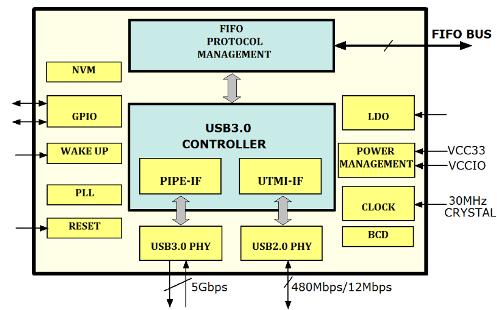
The FT600Q has a 16-bit wide FIFO bus interface and comes in a 56-pin QFN package while the FT601Q uses a 32-bit wide FIFO interface, packaged in a 76-pin QFN outline. The FT601 and FT600 support both the single-in and single-out 245 FIFO interfacing standard and the multi-channel FIFO mode which can handle a total of 8 channels (4 INs and 4 OUTs). The FIFO interface can support multi-voltage I/O (1.8 V, 2.5 V or 3.3 V) and an operating frequency of 66.67 MHz or 100 MHz (100 MHz only for 2.5 V and 3.3 V).
The devices support Link Power Management (LPM) to give improved power saving and also supports Suspend and Remote Wake-up signalling. If the USB is in suspend mode and Remote Wake-up has been enabled, driving the WAKEUP_N pin low causes the FT600 to request a ‘resume from suspend’ on the USB bus.
For more detail: FTDI Launch USB 3.0 Chip Using Arduino
-
What data transfer standards do the FT600 and FT601 support?
They support USB 3.0 Super Speed (5 Gb/s) and USB 2.0 High Speed (480 Mb/s). -
How does the FT600 differ from the FT601 in terms of interface width?
The FT600 has a 16-bit wide FIFO bus interface, whereas the FT601 uses a 32-bit wide FIFO interface. -
What voltage levels can the FIFO interface support?
The interface supports multi-voltage I/O including 1.8 V, 2.5 V, or 3.3 V. -
Can the devices operate at 100 MHz frequency?
Yes, but 100 MHz operation is only available when using 2.5 V or 3.3 V power levels. -
How many channels can the multi-channel FIFO mode handle?
The multi-channel mode can handle a total of 8 channels consisting of 4 INs and 4 OUTs. -
How does the device resume from suspend mode?
Driving the WAKEUP_N pin low causes the FT600 to request a resume from suspend on the USB bus if enabled. -
What power management features are included in these chips?
The devices support Link Power Management (LPM), Suspend, and Remote Wake-up signalling.
