
Summary of 12V TO 24V @ 1A STEP-UP SWITCHING REGULATOR USING LM2585
This project describes a DC-DC step-up converter using the LM2585-ADJ regulator. The regulator integrates a 3 A NPN switching transistor, a 100 kHz fixed-frequency oscillator, and protection features (current and thermal limiting, under-voltage lockout). It supports adjustable output via feedback resistors, soft-start to reduce inrush, current-mode control for input and load transient rejection, cycle-by-cycle current limiting, and an output voltage tolerance of ±4% under specified conditions.
Parts used in the DC-DC Step-Up Converter using LM2585-ADJ:
- LM2585-ADJ regulator (Texas Instruments)
- Feedback resistors R1 and R2
- Inductor (small magnetics suitable for 100 kHz)
- Diode suitable for switching regulator use
- Output capacitor(s)
- Input capacitor(s)
- Load resistor or load device (to draw output current)
- PCB or prototyping board and wiring
This is a DC-DC step-up converter based on LM2585-ADJ regulator manufactured by Texas Instruments.
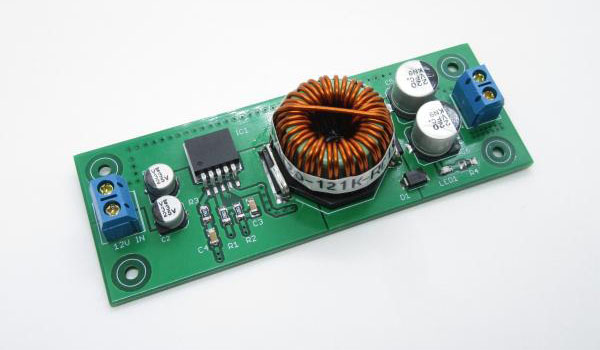
This IC was chosen for its simplicity of use, requiring minimal external components and for its ability to control the output voltage by defining the feedback resistors (R1,R2). NPN switching/power transistor is integrated inside the regulator and is able to withstand 3A maximum current and 65V maximum voltage. Switching frequency is defined by internal oscillator and it’s fixed at 100KHz.
The power switch is a 3-A NPN device that can standoff 65 V. Protecting the power switch are current and thermal limiting circuits and an under-voltage lockout circuit. This IC contains a 100-kHz fixed-frequency internal oscillator that permits the use of small magnetics.
Other features include soft start mode to reduce in-rush current during start-up, current mode control for improved rejection of input voltage, and output load transients and cycle-by-cycle current limiting. An output voltage tolerance of ±4%, within specified input voltages and output load conditions, is specified for the power supply system.
Read more: 12V TO 24V @ 1A STEP-UP SWITCHING REGULATOR USING LM2585
- What regulator is used in this step-up converter?
The LM2585-ADJ regulator from Texas Instruments is used. - How is the output voltage controlled?
The output voltage is controlled by defining the feedback resistors R1 and R2. - What is the maximum current and voltage rating of the integrated power switch?
The integrated NPN power switch can withstand up to 3 A and 65 V maximum. - What is the switching frequency of the regulator?
The regulator uses an internal fixed-frequency oscillator at 100 kHz. - Does the regulator include protection features?
Yes, it includes current and thermal limiting and an under-voltage lockout circuit. - Is there any feature to reduce inrush current during startup?
Yes, the IC includes a soft-start mode to reduce inrush current during startup. - How does the regulator handle input voltage and load transients?
It uses current-mode control for improved rejection of input voltage and output load transients and provides cycle-by-cycle current limiting. - What output voltage tolerance is specified?
An output voltage tolerance of plus or minus 4% is specified under specified input voltages and output load conditions.
