
Summary of Twisted RF beams achieve 32 GB/s
Scientists at USC have achieved a record-breaking data transmission speed of 32 gigabits per second using twisted radio waves. Led by Professor Alan Willner, this technique transmits multiple spatially collocated data streams through a single aperture over free space. Unlike optical systems, the radio method utilizes wider, more robust beams that better withstand obstacles and atmospheric turbulence while offering speeds 30 times faster than LTE.
Parts used in the Twisted RF Beam Project:
- Twisted radio waves
- Single aperture transmitter
- Single aperture receiver
- Free space transmission medium
Transmissions reach speeds of 32 gigabits per second
Contact: Robert Perkins at (213) 740-9226 or [email protected]
Building on previous research that twisted light to send data at unheard-of speeds, scientists at USC have developed a similar technique with radiowaves, reaching high speeds without some of the hassles that can go with optical systems.
The researchers, led by electrical engineering professor Alan Willner of the USC Viterbi School of Engineering, reached data transmission rates of 32 gigabits per second across 2.5 meters of free space in a basement lab at USC.
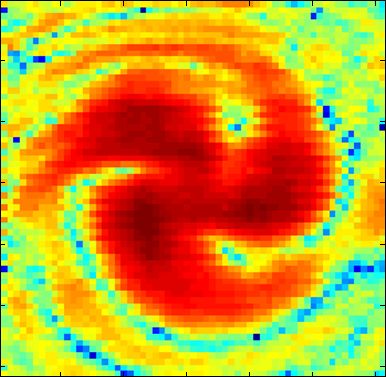
For reference, 32 gigabits per second is fast enough to transmit more than 10 hour-and-a-half-long HD movies in one second and is 30 times faster than LTE wireless.
“Not only is this a way to transmit multiple spatially collocated radio data streams through a single aperture, it is also one of the fastest data transmission via radio waves that has been demonstrated,” Willner said.
Faster data transmission rates have been achieved – Willner himself led a team two years ago that twisted light beams to transmit data at a blistering 2.56 terabits per second – but methods to do so rely on light to carry the data.
“The advantage of radio is that it uses wider, more robust beams. Wider beams are better able to cope with obstacles between the transmitter and the receiver, and radio is not as affected by atmospheric turbulence as optics,” Willner said.
For more detail: Twisted RF beams achieve 32 GB/s
- What speed did scientists achieve with twisted radio waves?
The researchers reached data transmission rates of 32 gigabits per second. - How does this speed compare to LTE wireless?
The new rate is 30 times faster than LTE wireless. - Can this system transmit multiple data streams?
Yes, it transmits multiple spatially collocated radio data streams through a single aperture. - Why are radio beams considered better than optical beams for this application?
Radio uses wider, more robust beams that cope better with obstacles and are less affected by atmospheric turbulence. - How much data can be transmitted in one second?
The speed is fast enough to transmit more than 10 hour-and-a-half-long HD movies in one second. - Did previous research use light instead of radio waves?
Yes, a team led by Willner previously twisted light beams to transmit data at 2.56 terabits per second. - Where was the experiment conducted?
The experiment took place across 2.5 meters of free space in a basement lab at USC. - Who led the research team?
The project was led by electrical engineering professor Alan Willner of the USC Viterbi School of Engineering.
