
Summary of TIG ANNOUNCES BLUETERA II OPEN SOURCE IOT MOTION-BASED DEVELOPMENT BOARD
Tensor Iotera Group (TIG) launched the Bluetera II, a second-generation open-source full-stack development board designed for motion-based IoT applications. It utilizes Google's Protocol Buffers and the Nordic nRF52840 SoC to simplify complex 3D motion math via the Madgwick sensor fusion algorithm. The board supports BLE 5.0, functions as a Central or peripheral, and offers extensive GPIO headers for connectivity, aiming to provide a robust, low-power, and extensible platform for developers.
Parts used in the Bluetera II:
- Nordic nRF52840 SoC
- Arm Cortex-M4 FPU
- 1MB Flash memory
- 256KB RAM
- BLE 5.0 controller
- BLE add-on modules
- Pair of 13-pin headers
- PWM interfaces
- SWD interfaces
- GPIOs
- Bluetera SDK
- Madgwick sensor fusion algorithm
- Google Protocol Buffers technology
Tensor Iotera Group (TIG) has announced its new Bluetera II open source full-stack development board, which according to the company uses Google’s Protocol Buffer technology for motion-based IoT applications. TIG says that the Bluetera II is the second generation module. Bluetera II is built to fill the gap for an open source platform that meets the following requirements :
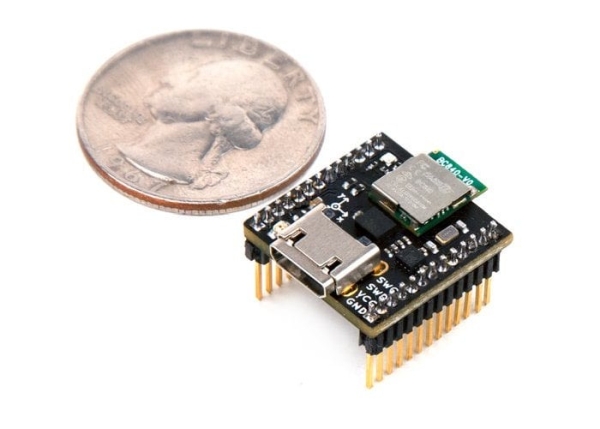
- A system-level API that properly encodes and delivers data from the end-node to the client application, often running on a mobile phone
- A way to simplify 3D motion data that would otherwise require users to master non-trivial and sometimes counter-intuitive concepts and mathematics
- Physical characteristics appropriate for an Internet of Things (IoT) platform: robust, low-power, extensible, and as small as possible
The company says
Developers of IoT platforms often struggle with motion math: quaternions, calibration, angles, transformation, logging, etc. The Bluetera SDK’s motion library provides common open-source algorithms and calculations to help reduce this sort of complexity. Using the Madgwick sensor fusion algorithm, for example, Bluetera II is capable of streaming 200 Hz of quaternion data (OS-dependent)… Protocol Buffers is a battle-tested, schema-based serialization library developed by Google. An SDK built on Protocol Buffers allows our API to pass information between the various layers of an IoT system in a way that is efficient, extensible, and even beautiful. That API, which integrates with Nordic’s nRF SDK, will save you from having to do a great deal of boring, time-consuming, error-prone work that requires expertise in many different frameworks.
The Bluetera II is equipped with the latest Nordic nRF52840 SoC, which can function as a BLE Central and a BLE peripheral. The hub is capable of being connected to a Linux or a Windows-based USB port as a BLE dongle. Then, it can become an integral part of the Bluetera LAN interacting with multiple Bluetera hub modules. The Bluetera II which features Nordic’s nRF52840, enables an Arm Cortex-M4 FPU, with 1MB of Flash, and 256KB of RAM. A BLE 5.0 controller is also incorporated with the MCU for wireless communications, but TIG offers BLE add-on modules for short, long, and ultra-long applications. The Bluetera II also features a pair of 13-pin headers, each of the headers are equipped with PWM, SWD, and GPIOs that can be configured as UART, I²C, ADC, etc.
Read more: TIG ANNOUNCES BLUETERA II OPEN SOURCE IOT MOTION-BASED DEVELOPMENT BOARD
- What technology does the Bluetera II use for data encoding?
The device uses Google's Protocol Buffer technology to encode and deliver data from the end-node to the client application. - How does the Bluetera II simplify 3D motion data?
It uses the Madgwick sensor fusion algorithm within its SDK to handle complex calculations like quaternions and calibration. - Can the Bluetera II function as both a BLE Central and peripheral?
Yes, the Nordic nRF52840 SoC allows the hub to function as either a BLE Central or a BLE peripheral. - What is the streaming rate of quaternion data on the Bluetera II?
The module is capable of streaming 200 Hz of quaternion data, though this may be OS-dependent. - Does the Bluetera II support connection to Linux or Windows systems?
Yes, the hub can connect to a Linux or Windows-based USB port to act as a BLE dongle. - What communication interfaces are available on the 13-pin headers?
The headers support PWM, SWD, and GPIOs that can be configured as UART, I²C, or ADC. - Is the Bluetera II compatible with Nordic's nRF SDK?
Yes, the API integrates directly with Nordic's nRF SDK to streamline development. - Are there options for extended wireless range?
TIG offers BLE add-on modules specifically designed for short, long, and ultra-long application ranges.
