
Summary of Stand Alone AVR Programmer
The Solder Lab Easy Auto Programmer V1.0 automates AVR chip flashing, fuse setting, and verification without a PC. It uses an SD card to store hex files and features a ZIF socket for THT chips or a 6-pin ISP header for in-circuit programming. Powered by 7-20V, the device operates via a Nokia display and buttons to select files and execute tasks with a single button press.
Parts used in the Solder Lab Easy Auto Programmer V1.0:
- AVR microcontroller (Virgin ATMegas)
- SD-card
- Nokia 5110 Display
- Zero Insertion Force Socket (ZIF-Socket)
- 6-pin ISP interface
- Power supply (7-20V)
- Three push buttons
- FAT32 formatted SD card containing "hex" folder
- 6-pin ribbon wire (for ISP programming)
From project to project the number of hex files on our PC was increasing. Many people send us their virgin ATMegas to get them flashed. And last not least distributing PCB’s and pre-flahed chips via agile-hardware forced us to burn many, many AVRs. In principle this is a work an ape should do but reality was different. So we spend munch time in this boring job. To much time …
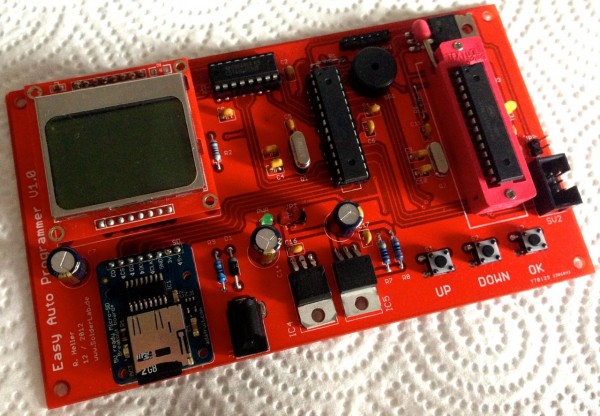
Thus it was just consequent to think about a device that would do the job for us. Here is the result, the Solder Lab Easy Auto Programmer V1.0. An All-in-one AVR programmer with SD-card, Nokia Display, a ZIF-Socket and a 6-pin ISP interface. With this device the programming of an AVR is done in seconds including the setting of fuse bits (before AND after flashing), flashing the chip, verifying the flash. And all this without any connection to the PC and by pressing just one single button. You just have to put all your hex files into a folder called “hex” on a standard FAT32 formatted SD card, put the card into the programmer an supply it with some voltage (7-20V). That’s it the rest is done by the “ape”.
To make this job even more efficient the programmer boards includes a Zero Insertion Force Socket (ZIF) for fastest change of chips. But that does not necessarily mean that you are restricted to THT chips! The board also has a standard 6-pin ISP header that allows you to program AVRs in their circuit (if they have an ISP header too) all you need in this case is a 6-pin ribbon wire. The selection of the correct hex file in your “hex” folder on the SD card is done via the build-in Nokia 5110 display and three push buttons on the board.
For More Details: Stand Alone AVR Programmer
-
How does the programmer operate without a PC?
You place hex files in a "hex" folder on a FAT32 SD card, insert the card into the programmer, supply voltage, and press one button. -
Can this device program AVRs while they are still in a circuit?
Yes, using the standard 6-pin ISP header and a 6-pin ribbon wire if the target AVR has an ISP header. -
What power range is required to run the programmer?
The device requires a voltage supply between 7 and 20 volts. -
How do you select the correct hex file for programming?
The built-in Nokia 5110 display and three push buttons allow you to select the correct hex file from the SD card. -
Does the programmer support Zero Insertion Force sockets?
Yes, the board includes a Zero Insertion Force Socket for fastest change of THT chips. -
What steps are included in the automated programming process?
The device handles setting fuse bits before and after flashing, flashing the chip, and verifying the flash. -
What type of SD card formatting is required?
A standard FAT32 formatted SD card is needed to store the hex files. -
Is it possible to use THT chips with this programmer?
Yes, despite the ZIF socket being designed for THT chips, the board supports them efficiently.
