
Summary of SMALL MULTI-BAND GNSS RECEIVER WITH 1-CM POSITION ACCURACY
SkyTraq announced the PX1122R, a 12×16 mm multi-band RTK GNSS receiver delivering centimeter-level positioning. It processes GPS L1/L2C, Galileo E1/E5b, GLONASS L1/L2, and Beidou B1I/B2I concurrently. The single-chip SoC design yields the market's smallest, lowest-power multi-band RTK module, with RTK initialization under 10 seconds, up to 10 Hz update rate, and support for moving-base RTK for precise heading (0.13° 1-sigma with two units and 1 m antenna baseline). Target applications include autonomous vehicles, IoT precise positioning, land surveying, and precision farming.
Parts used in the PX1122R:
- PX1122R multi-band RTK GNSS receiver module (12 × 16 mm)
- GPS L1/L2C signal support
- Galileo E1/E5b signal support
- GLONASS L1/L2 signal support
- Beidou B1I/B2I signal support
- Single-chip SoC design (integrated in PX1122R)
- GNSS antennas (for single-unit positioning)
- Two GNSS antennas and two PX1122R modules (for moving-base RTK heading)
SkyTraq announced a 12- x 16-mm size PX1122R multi-band RTK receiver for centimeter-level accuracy GNSS positioning applications.
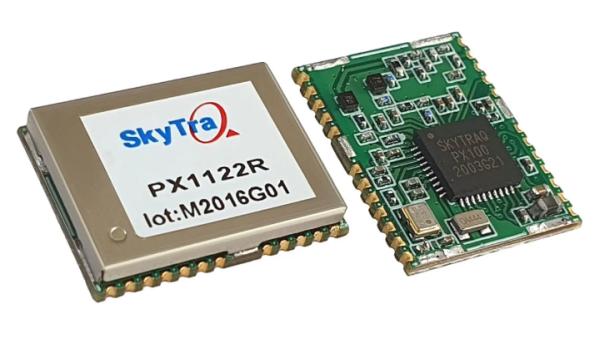
The receiver works with all the four global navigation satellite systems using GPS L1/L2C, Galileo E1/E5b, GLONASS L1/L2, and Beidou B1I/B2I signals concurrently to maximize positioning availability even in difficult urban environments. Based on single-chip SoC design, PX1122R is currently the smallest size, lowest power, multi-band multi-GNSS RTK receiver module on the market.
The PX1122R is designed to deliver reliable, centimeter-level accuracy positioning for precision guidance of emerging autonomous unmanned ground or aerial vehicle, Internet-of-Things precise positioning, and also the traditional land surveying and precision farming applications. The PX1122R has RTK initialization time under 10 seconds and maximum update rate of 10 Hz. Its twice update rate than peer provides in-time positioning information with faster response time and improved guidance performance for fast moving applications.
Moving base RTK for GNSS precise heading is also supported. By using two PX1122R and two antennas with 1 meter separation, highly accurate 1-sigma heading accuracy of 0.13 degree can be obtained; such heading accuracy is immune to magnetic interference nor affected by receiver’s speed.
Read more: SMALL MULTI-BAND GNSS RECEIVER WITH 1-CM POSITION ACCURACY
- What satellite systems does the PX1122R support?
The PX1122R supports GPS L1/L2C, Galileo E1/E5b, GLONASS L1/L2, and Beidou B1I/B2I concurrently. - What is the size of the PX1122R module?
The PX1122R measures 12 × 16 mm. - What positioning accuracy does the PX1122R provide?
The PX1122R provides centimeter-level positioning accuracy (1-cm accuracy referenced in the announcement). - How fast does the PX1122R acquire RTK?
RTK initialization time is under 10 seconds. - What is the maximum update rate of the PX1122R?
The PX1122R has a maximum update rate of 10 Hz. - Can the PX1122R be used for precise heading?
Yes; using two PX1122R modules with two antennas separated by 1 meter provides 1-sigma heading accuracy of 0.13 degree. - Is the PX1122R suitable for autonomous vehicles?
Yes; it is designed for precision guidance of autonomous unmanned ground or aerial vehicles among other applications. - Does the PX1122R offer resistance to magnetic interference for heading?
Yes; the heading accuracy obtained with two PX1122R modules is immune to magnetic interference and not affected by receiver speed.
