
Summary of PICnano breadboard based on PIC18F2550
Summary: A PICnano breadboard module based on the PIC18F2550 was designed as a compact, Arduino-Nano-like board for battery-powered projects (3.7V Li‑Ion). It exposes the microcontroller power supply directly, includes USB support without external transceivers, and runs from 2V. The design provides basic required components (decoupling caps, reset button, mini‑USB, external oscillator) for standalone PIC operation in a 28‑pin SOIC package.
Parts used in the PICnano breadboard based on PIC18F2550:
- PIC18F2550 microcontroller (28-pin SOIC)
- Decoupling capacitors
- Reset pushbutton
- Mini-USB connector
- External oscillator
- Linear regulator U3 (on Arduino Nano reference, removable in some scenarios)
- Breadboard-compatible header pins
Hi all! With a bit of delay, here’s my last work, a PICnano breadboard based on the PIC18F2550microcontroller. I have in mind a new project and I want to use an small board, like the Arduino Nano board. This new project is battery powered (3,7V Li-Ion battery). After checking the schematics of the Arduino Nano, I see that the microcontroler is powered at 5V. Of course, I can unmount the linear regulator (U3) that is on the board, and bypass the VIN to the microcontroller power supply. But I think it’s funny try to develop a new module when you’ve access to the microcontroller power supply! Also, I want to work with PIC microcontrollers after many years, so here’s what I design!
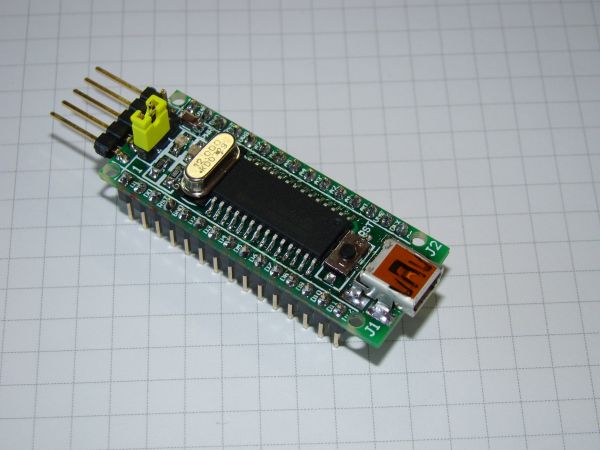
- The Hardware
The goal of this new design is try to have an Arduino Nano compatible module but with some new features, such have direct access to the power supply microcontroller. First of all, here you can download the schematic of the board: PICNANO BREADBOARD SCHEMATIC V1.0
The board is based on the PIC18F2550 microcontroller, here you can download the datasheet. It’s an 8-bit microcontroller with these features (from the Microchip’s page):
These characteristics are enough for many of the small projects I usually do. The two features that are more important for me at this time are:
– It has a full speed 2.0 USB internal module, so you don’t need external transceivers to have a USB interface.
– Power supply starts at 2V, so it’s perfect for a battery powered systems.
The schematic is dividen in functinal blocks:
PIC18F2550 Microcontroller
The main part of the board. It has the basic elements to work with the PIC without external componentes: decoupling capacitors, reset pushbutton, mini-USB connector and external oscillator. And, obviously, the PIC18F2550 microcontroller in 28-pin SOIC package.
For more detail: PICnano breadboard based on PIC18F2550
- What microcontroller is used in the PICnano breadboard?
The board uses the PIC18F2550 microcontroller in a 28-pin SOIC package. - Can the PICnano run from a single Li-Ion battery?
Yes, the PIC18F2550 power supply starts at 2V making it suitable for a 3.7V Li-Ion battery powered system. - Does the board require external USB transceivers?
No, the PIC18F2550 has a full speed USB 2.0 internal module so external transceivers are not needed. - What basic components are included so the PIC can run without external parts?
The design includes decoupling capacitors, a reset pushbutton, mini-USB connector, and an external oscillator. - Is the microcontroller power supply accessible on the board?
Yes, the design provides direct access to the microcontroller power supply. - Can you bypass the Arduino Nano regulator to power the microcontroller directly?
Yes, on an Arduino Nano you can remove the linear regulator U3 and bypass VIN to the microcontroller power supply; the PICnano instead exposes the microcontroller supply directly. - Where can I find the PICnano schematic?
The article provides a link to download PICNANO BREADBOARD SCHEMATIC V1.0. - Why choose PIC18F2550 for this design?
Because it offers USB 2.0 full speed internally and low-voltage operation starting at 2V, suitable for battery projects.
