
Summary of New Battery Charging Solutions for Li-ion Cells
This article discusses the evolution of portable battery technologies, highlighting advancements from nickel-cadmium (NiCd) to newer chemistries like NiMH, Li-ion, and Li-poly. These modern batteries offer higher capacity, lighter weight, and faster charging but require sophisticated protection circuitry. The text notes specific limitations, such as NiMH's high self-discharge rate, and mentions that semiconductor suppliers including Maxim Integrated, Linear Technology, and Texas Instruments provide advanced charging solutions for these cells.
Parts used in New Battery Charging Solutions:
- Nickel-metal hydride (NiMH) batteries
- Lithium-ion (Li-ion) batteries
- Lithium-polymer (Li-poly) batteries
- Nickel cadmium (NiCd) technology
- Charging and protection circuitry
- Semiconductor devices
- Maxim Integrated components
- Linear Technology components
- Texas Instruments components
Over the years, demand for efficient, light, fast-charging, safe, and cost-effective portable power has led to development of many new battery technologies, including nickel-metal hydride (NiMH), rechargeable alkaline, lithium-ion (Li-ion), and lithium-polymer (Li-poly), to name a few.
Generally speaking, these new battery chemistries require more sophisticated charging and protection circuitry to maximize performance and ensure safety. Fortunately, equally advanced semiconductor devices to charge and protect them have also been developed.
This article explores the virtues and limitations of the newer battery technologies. It also investigates and reports on new charging solutions for Li-ion batteries from semiconductor suppliers like Maxim Integrated, Linear Technology, and Texas Instruments.
Battery technologies
In the portable electronic equipment space, several new rechargeable battery chemistries have emerged in recent years to compete with the long-favored nickel cadmium (NiCd) technology, which continues to be attractive in applications such as power tools, where high current for short periods is needed and where the low-impedance characteristics of NiCd is desirable.
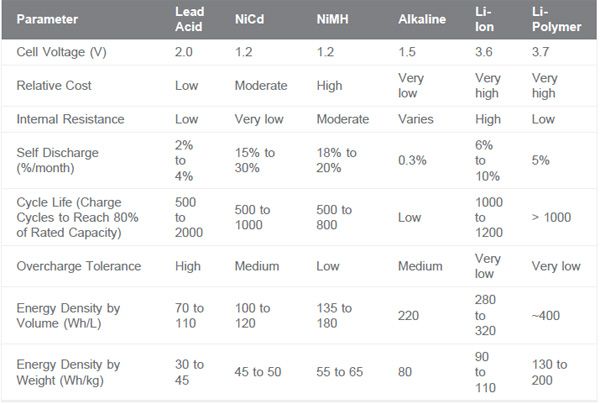
However, designers of modern portable applications such as smartphones, tablets, and digital cameras are in pursuit of batteries with higher capacity and lower discharge rates as compared to NiCd. In addition, these applications demand batteries that can charge quickly and offer low weight. Battery technologies meeting these requirements include nickel metal hydride (NiMH), lithium-ion (Li-ion) and lithium-polymer (Li-poly). While NiMH batteries feature greater capacity and faster charging, their limitation is a higher self-discharge rate, twice that of NiCd, which is relatively high to begin with (Table 1).
For more detail: New Battery Charging Solutions for Li-ion Cells
- Why are new battery chemistries required for smartphones?
Designers need batteries with higher capacity, lower discharge rates, quick charging, and low weight compared to NiCd. - What is a limitation of NiMH batteries?
NiMH batteries have a higher self-discharge rate, which is twice that of NiCd. - Which battery technology remains attractive for power tools?
Nickel cadmium (NiCd) technology is still desirable for power tools due to its high current capability and low-impedance characteristics. - Do new battery types require different charging equipment?
Yes, they generally require more sophisticated charging and protection circuitry to ensure safety and maximize performance. - Which semiconductor suppliers offer Li-ion charging solutions?
Suppliers mentioned include Maxim Integrated, Linear Technology, and Texas Instruments. - How does the self-discharge of NiMH compare to NiCd?
The self-discharge rate of NiMH is twice that of NiCd. - What are the main goals for modern portable applications regarding batteries?
Applications demand batteries with higher capacity, faster charging, lower weight, and lower discharge rates.
