
Summary of Moore’s Law extends to cover human progress
Moore's Law describes the exponential growth of computing power, driven by a cycle of incremental improvements where engineers continuously refine components. While originally focused on transistor density doubling every 18 months, this principle applies to various technologies with different timescales. The growth stems from human motivation and ingenuity rather than just economic factors; as long as incentives exist and physical laws allow, small percentage gains accumulate into significant advancements over time.
Parts used in Moore's Law Analysis:
- Transistor density
- Computing power systems
- Engineers and colleagues
- Economic supply and demand incentives
- Moral or aesthetic incentives
- Physical constraints (laws of thermodynamics)
- Technological loopholes
- Incremental improvement cycles
Moore’s Law, famous for predicting the exponential growth of computing power over 40 years, comes from a simple try-fail/succeed model of incremental improvement. The predictive success of Moore’s Law seems uncanny, so let’s take a closer look to get an idea of where it comes from.
Moore conceived his law for computational power but Moore’s-like growth laws permeate human endeavor—a fact that had never occurred to me until I went to a presentation by Lawrence Berkeley National Lab energy researcher, Robert van Buskirk. He showed several technologies that improve according to Moore’s law, but with different timescales than the original. You can read his paper here, notably co-authored by Nobel Laureate and former Secretary of the Department of Energy, Steven Chu.
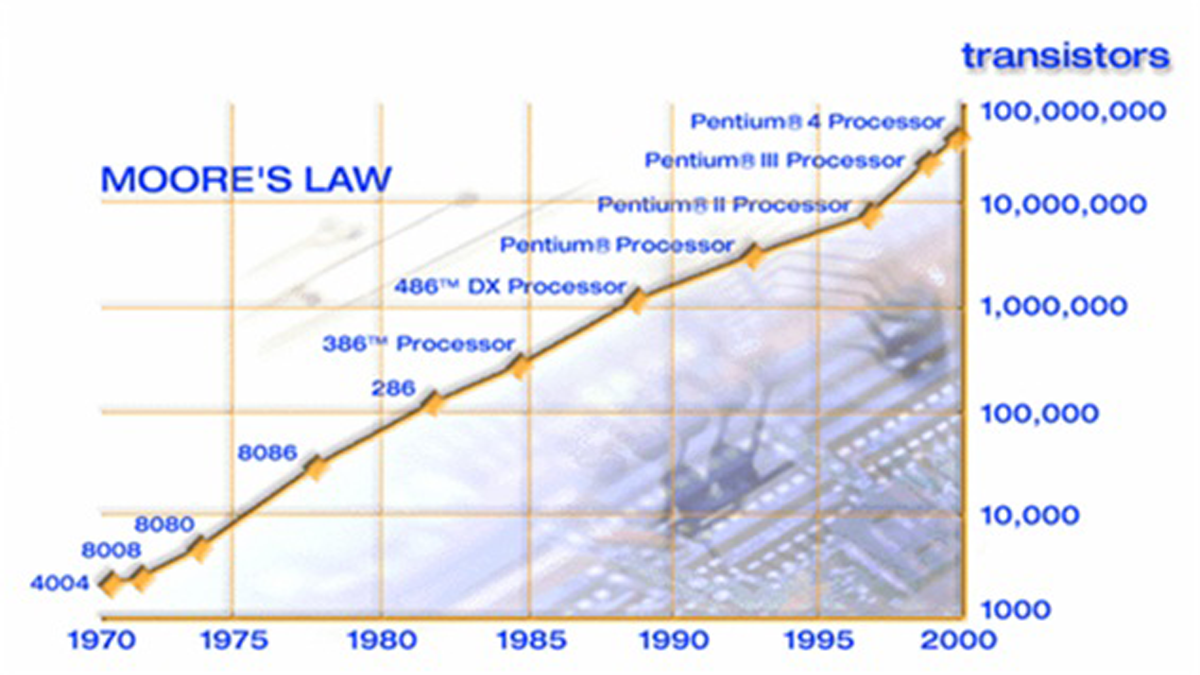
Let’s take a quick look at Moore’s Law for computing power (Figure 1) and then see where it and other exponential improvements come from. Right about every 18 months for the past 40 years, transistor density has doubled and there’s no sign of the trend slowing down.
Gordon Moore proposed that, as long as there is incentive, techniques will improve, components will shrink, prices will scale, the cycle will repeat and we’ll continue to see exponential growth. Van Buskirk has evidence that the driving incentive is not limited to economic supply and demand arguments but can also include far weaker incentives such as simply being aware that a quality is desirable for moral or aesthetic reasons.
Moore’s-like laws emerge from the simple fact that you and all of your colleagues keep on making improvements as long as you’re both motivated and improvements are possible. As far as the latter requirement is concerned, I don’t have to tell you how clever engineers can be. While no one is going to violate the laws of thermodynamics—no perpetual motion machines or perfect engines—engineers are pretty good at pushing right up to those constraints and sometimes finding loopholes.
Start with something—a system or a doodad—that works with some proficiency. Along with thousands of other engineers, you set out to improve your doodad. You try stuff. Most of the stuff you try doesn’t work, but now and then, you improve the performance of the doodad by some percentage, maybe 0.1%, maybe 10%, maybe you have a disrupting idea that improves it by 1000%. Mostly, we experience many small, 1%-ish improvements. Meanwhile, all of your colleagues around the world are pushing the same envelope but in different directions.
For More Details: Moore’s Law extends to cover human progress
-
What is the core mechanism behind Moore's Law?
It emerges from a simple try-fail/succeed model where motivated individuals make continuous incremental improvements. -
How often does transistor density double according to Moore's Law?
Transistor density has doubled approximately every 18 months for the past 40 years. -
Does economic supply and demand drive all aspects of Moore's Law?
No, incentives can also include weaker factors like moral or aesthetic desires for quality. -
Can engineers violate the laws of thermodynamics to improve performance?
No, engineers cannot violate these laws but are skilled at pushing right up to those constraints. -
What types of performance improvements are most common?
Most experiences involve many small, roughly 1% improvements rather than massive disruptions. -
Do Moore's-like laws apply only to computing technology?
No, these laws permeate human endeavor and apply to several other technologies with different timescales. -
What happens when an engineer tries new methods for improvement?
Most attempts do not work, but occasionally they result in significant performance increases.
