
Summary of minDUINO v1.5, a small footprint, educational Arduino clone
The minDUINO v1.5 is an open-source, educational Arduino™ clone designed for easy assembly using a two-layer through-hole circuit. Created by ProjectAVR to encourage experimentation, particularly for young learners like Amelia, it features headers for FTDI, ISCP, and port breakouts. The design supports expansion via daughter boards or perfboard integration and is released under a Creative Commons license for free adaptation with attribution.
Parts used in the minDUINO v1.5:
- Two-layer through-hole circuit board
- FTDI headers
- ISCP headers
- Port breakout headers
- Daughter boards (for expansion)
- Stripboard or perfboard (optional pairing)
- Header sockets
minDUINO v1.5
minDUINO v1.5 – A Small Footprint, Educational Arduino™ clone.
This webpage holds all the design files and information to make and program the minDUINO v1.5 board. The design is released under Creative Commons Attribution Share-Alike. This means that you can freely copy the design and adapt it for your own purposes provided you attribute the design to ‘ProjectAVR – Steve Smith G0TDJ’ and use the same license for your adapted designs. Full information on the Creative Commons website. The intention is to make this design Open Hardware. The v1.5 board is as yet untested although the circuit is basically the same. v1.4 board design files are still available here.
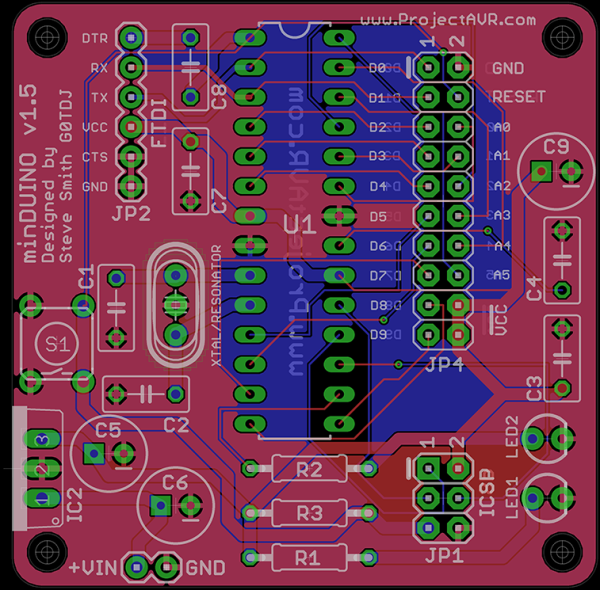
If you look online you will find a myriad of Arduino™ clones of all different shapes and sizes. So why would I want to produce yet another? The truth is, I love designing things. I was also inspired to create this board because my friends daughter, I will call her Amelia, has found an interest in electronics. Amelia’s father and I have given her several things to build, commercially available kits, but I wanted to encourage her to experiment. Since I have a familiarity with AVRs and Arduino™, I elected to follow that path.
The minDUINO is designed to be easy to assemble, so it is a two layer through-hole design, not SMD. It has headers for FTDI, ISCP and port breakouts. Another project I designed was VAYU-NTX, a High Altitude Balloon Tracker. As expansion for this, I designed two small daughter boards for experimenting with. I followed a similar idea with the minDUINO and placed the breakout headers together. Later on, I may design a bespoke board but its just as easy to use stripboard/perfboard paired with the appropriate header socket.
For more detail: minDUINO v1.5, a small footprint, educational Arduino clone
- What is the minDUINO v1.5?
It is a small footprint, educational Arduino clone designed as open hardware. - How can I use this design for my own purposes?
You can freely copy and adapt the design provided you attribute ProjectAVR and use the same Creative Commons license. - Does the board use surface mount components?
No, it uses a two-layer through-hole design to ensure it is easy to assemble. - What headers are included on the board?
The board includes headers for FTDI, ISCP, and port breakouts. - Can I expand the functionality of the minDUINO?
Yes, you can use daughter boards or pair the board with stripboard and appropriate header sockets. - Who inspired the creation of this board?
The creator was inspired by his friend's daughter, Amelia, who developed an interest in electronics. - Is the v1.5 board currently tested?
The v1.5 board is untested, though the circuit is basically the same as the v1.4. - Under what license is the design released?
The design is released under Creative Commons Attribution Share-Alike.
