
Summary of LTC2875 – ±60V Fault Protected 3.3V or 5V 25kV ESD High Speed CAN Transceiver
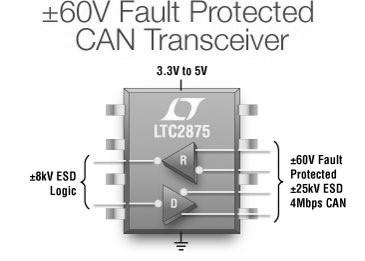
The LTC2875 is a high-speed, low-power CAN transceiver supporting 3.3V or 5V supplies with ±60V overvoltage protection and 4Mbps data rates. It features robust ESD protection (±25kV), extended common mode range (±36V), and active symmetry control for low electromagnetic emission. Designed for industrial, automotive, and medical applications, it includes thermal shutdown, glitch-free outputs, and ISO 11898-2 compliance in compact 3mm × 3mm packages.
Parts used in the LTC2875 CAN Transceiver:
- LTC2875 Transceiver Chip
- 3.3V Supply Voltage
- 5V Supply Voltage
- Data Transmission Lines
- Transmitter Data (TXD) Input
- SPLIT Pin for Termination
- 3mm × 3mm 8-Lead DFN Package
- SO-8 Package
Features
- Protected from Overvoltage Line Faults to ±60V
- 3.3V or 5V Supply Voltage
- High Speed Operation Up to 4Mbps
- ±25kV ESD Interface Pins, ±8kV All Other Pins
- Variable Slew Rate Driver with Active Symmetry Control and SPLIT Pin for Low Electromagnetic Emission (EME)
- Extended Common Mode Range (±36V)
- Ideal Passive Behavior to CAN Bus with Supply Off
- Current Limited Drivers and Thermal Shutdown
- Power-Up/Down Glitch-Free Driver Outputs
- Micropower Shutdown Mode
- Transmit Data (TXD) Dominant Timeout Function
- ISO 11898-2 Compliant
- DeviceNet Compatible
- Up to MP-Grade Available (–55°C to 125°C)
- 3mm × 3mm 8-Lead DFN and SO-8 Packages
-
Description
The LTC®2875 is a robust high speed, low power CAN transceiver operating on 3.3V or 5V supplies that features ±60V overvoltage fault protection on the data transmission lines during all modes of operation, including power-down. The maximum data rate has been extended to 4Mbps to support high speed protocols based on the CAN physical layer. Enhanced ESD protection allows these parts to withstand ±25kV HBM on the transceiver interface pins without latchup or damage.
Extended ±36V input common mode range and high common mode rejection on the CAN receiver provides tolerance of large ground loop voltages. A sophisticated CAN driver with active symmetry control maintains tight control of the common mode voltage for excellent electromagnetic emission, while the variable slew rate and split termination support allow additional EME reduction.
Applications
- Industrial Control and Instrumentation Networks
- Automotive and Transportation Electronics
- Building Automation, Security Systems, HVAC
- Medical Equipment
-
People Who Viewed This Product Also Viewed
For more detail: LTC2875 – ±60V Fault Protected 3.3V or 5V 25kV ESD High Speed CAN Transceiver
- What supply voltages does the LTC2875 support?
The device operates on 3.3V or 5V supplies. - How much overvoltage fault protection does the part offer?
It provides protected operation from line faults up to ±60V during all modes including power-down. - Can the LTC2875 operate at high speeds?
Yes, it supports high speed operation up to 4Mbps. - Does the device have ESD protection on interface pins?
Yes, it withstands ±25kV HBM on the transceiver interface pins without latchup or damage. - What is the common mode range of the receiver?
The receiver offers an extended common mode range of ±36V. - How does the driver reduce electromagnetic emission?
It uses variable slew rate drivers with active symmetry control and a SPLIT pin for low EME. - Is the device compliant with industry standards?
Yes, it is ISO 11898-2 compliant and DeviceNet compatible. - What package options are available for this component?
Available in 3mm × 3mm 8-Lead DFN and SO-8 packages.
