
Summary of IOT based Air Pollution Monitoring System using Arduino
This project builds an IoT-based air pollution monitoring system using an MQ135 gas sensor, Arduino Uno, and ESP8266 to display PPM values on a 16x2 LCD and a webserver. It triggers an alarm (buzzer) when pollution exceeds a set level and can remotely monitor and act (e.g., switch on exhaust fan or send alerts). ESP8266 requires 3.3V and a voltage divider on its RX line; TX connects to Arduino pin 10 and RX (through resistors) to pin 9.
Parts used in the IOT Based Air Pollution Monitoring System:
- MQ135 Gas sensor
- Arduino Uno
- Wi-Fi module ESP8266
- 16X2 LCD
- Breadboard
- 10K potentiometer
- 1K ohm resistors
- 220 ohm resistor
- Buzzer
In this project we are going to make an IOT Based Air Pollution Monitoring System in which we will monitor the Air Quality over a webserver using internet and will trigger a alarm when the air quality goes down beyond a certain level, means when there are sufficient amount of harmful gases are present in the air like CO2, smoke, alcohol, benzene and NH3. It will show the air quality in PPM on the LCD and as well as on webpage so that we can monitor it very easily.
Previously we have built the LPG detector using MQ6 sensor and Smoke detector using MQ2 sensor but this time we have used MQ135 sensor which is the best choice for monitoring Air Quality as it can detects most harmful gases and can measure their amount accurately. In this IOT project, you can monitor the pollution level from anywhere using your computer or mobile. We can install this system anywhere and can also trigger some device when pollution goes beyond some level, like we can switch on the Exhaust fan or can send alert SMS/mail to the user.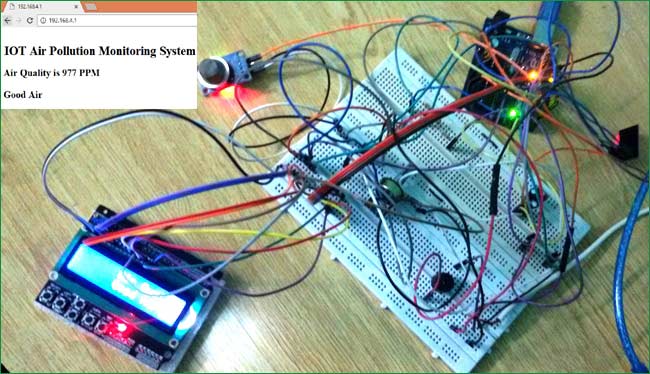
Required Components:
- MQ135 Gas sensor
- Arduino Uno
- Wi-Fi module ESP8266
- 16X2 LCD
- Breadboard
- 10K potentiometer
- 1K ohm resistors
- 220 ohm resistor
- Buzzer
Circuit Diagram and Explanation:
First of all we will connect the ESP8266 with the Arduino. ESP8266 runs on 3.3V and if you will give it 5V from the Arduino then it won’t work properly and it may get damage. Connect the VCC and the CH_PD to the 3.3V pin of Arduino. The RX pin of ESP8266 works on 3.3V and it will not communicate with the Arduino when we will connect it directly to the Arduino. So, we will have to make a voltage divider for it which will convert the 5V into 3.3V. This can be done by connecting three resistors in series like we did in the circuit. Connect the TX pin of the ESP8266 to the pin 10 of the Arduino and the RX pin of the esp8266 to the pin 9 of Arduino through the resistors.
Read More: IOT based Air Pollution Monitoring System using Arduino
- What does the project monitor?
The project monitors air quality and shows pollutant levels in PPM using an MQ135 sensor. - Can the system be accessed remotely?
Yes, the system publishes air quality on a webserver so it can be monitored from a computer or mobile. - Which sensor is used for detecting multiple harmful gases?
The MQ135 gas sensor is used because it detects most harmful gases like CO2, smoke, alcohol, benzene, and NH3. - How does the system alert when pollution is high?
The system triggers an alarm using a buzzer when air quality goes beyond a certain level. - What voltage does the ESP8266 require?
The ESP8266 requires 3.3V for VCC and CH_PD. - Do you need a voltage divider for the ESP8266 RX pin?
Yes, a voltage divider made from resistors is used to convert Arduino 5V signals to 3.3V for the ESP8266 RX pin. - Which Arduino pins connect to the ESP8266 serial lines?
The ESP8266 TX connects to Arduino pin 10 and ESP8266 RX connects to Arduino pin 9 through resistors. - Can the system activate external devices when pollution is high?
Yes, the system can trigger devices like an exhaust fan when pollution exceeds a set threshold.
